NC State, NYPA and EPRI Demonstrate Megawatt-Class Solid-State Transformer
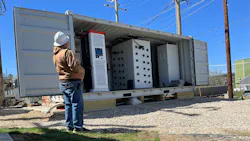
North Carolina State University, in collaboration with the New York Power Authority (NYPA) and EPRI, has designed and tested a high-efficiency solid-state transformer (SST) capable of handling up to 1 MW of power under real-world conditions.
Supported by NYPA and demonstrated at EPRI’s laboratory in Lenox, Massachusetts, the system highlights the technology’s potential to improve energy efficiency at installations with significant power demands, including data centers, while potentially reducing grid operating costs. The SST also can reduce heat loss associated with power conversion. Its compact size makes it suitable for applications where space is limited, including urban areas.
“This is the first independently verified, megawatt-class solid-state transformer validated on a live utility distribution feeder,” says Srdjan Lukic, principal investigator on the SST project and Lampe Distinguished Professor of Electrical and Computer Engineering at NC State. “This is a significant step in advancing power transformer technology.”
The SST prototype was designed, constructed, tested and deployed by NC State students and faculty. The prototype used in the NYPA-supported, EPRI-supervised demonstration was connected to a real distribution feeder at EPRI’s power delivery laboratory.
Conventional transformer-and-rectifier systems are about 96% efficient, meaning approximately 4% of the power is typically lost as heat during conversion. SSTs combine the functions of a transformer and an AC/DC rectifier and can reduce those losses, with only about 2% of power being wasted.
Given the need to maximize system capacity to support data centers and other large-scale projects, a highly efficient SST can provide potential cost savings, produce less heat and reduce the amount of electricity that needs to be generated and transmitted for an application. SSTs also are smaller than conventional transformer-and-rectifier technologies, making them better suited for settings where space is constrained, such as urban areas.
“SSTs take up less space,” says Lukic. “That can be important when considering large-scale projects such as data centers that can have a large footprint but also require their own power source in close proximity.”
NYPA, the nation’s largest state public power utility, collaborated with NC State to develop the transformer because of its potential benefits to utility operations. SSTs can enhance grid efficiency and support renewable integration, bidirectional power flow and voltage regulation to help address increasing demand associated with data centers and electric vehicle charging stations.
Ramadan Elmoudi, senior research, technology and development engineer at NYPA, who served as a project lead, said, “We learned through the project’s positive outcomes that solid-state transformers can serve as another tool in our clean energy toolbox to enable New York State to operate and maintain a compact, efficient and resilient grid.”
“It is encouraging to see innovative technologies progress from university laboratories to full-scale testing,” said Drew McGuire, EPRI senior director of Transmission and Distribution Research. “This collaboration was a powerful way to accelerate understanding and development of technologies like this SST.”
EPRI’s role in testing the technology is significant because the organization helps utilities test new technologies, such as the SST, and develop implementation strategies for adopting those technologies. Through this collaboration, the advancement can now be shared with the industry to benefit technology developers, utilities and the public.
The work was initially funded by the U.S. Department of Energy’s Transportation Technologies Office (TTO) under award DE-EE0008450. NYPA funded and contributed to the SST construction and field-testing aspects of the project.