Utilities, Regulators Grapple With Data Center Growth and Grid Reliability at IEEE PES T&D
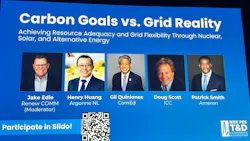
At the 2026 IEEE PES T&D Conference in Chicago, utility executives, regulators and researchers delivered a candid assessment of the growing tension between aggressive carbon reduction goals and the realities of maintaining a reliable electric grid amid surging demand.
The panel, titled “Carbon Goals vs. Grid Reality: Achieving Resource Adequacy and Grid Flexibility Through Nuclear, Solar and Alternative Energy,” brought together leaders from across the energy ecosystem, including Gil Quiniones of ComEd, Patrick Smith of Ameren Illinois, Doug Scott of the Illinois Commerce Commission, and Henry Huang of Argonne National Laboratory. Moderated by Jake Edie of RenewComm, the discussion centered on a simple but increasingly urgent question: how can utilities maintain reliability while transitioning to a cleaner energy future?
Panelists agreed that the era of flat electricity demand is over. Quiniones said ComEd’s peak demand remained relatively steady for more than a decade due to aggressive energy efficiency efforts and the rapid growth of community solar. But in the past several years, load growth has accelerated sharply, driven largely by data centers and electrification. He noted that ComEd now has roughly 40 gigawatts of potential data center load in its development pipeline — nearly double the utility’s historic peak demand of 23.8 gigawatts in July 2011. "It's been flat since 2011, but since about two to three years ago, we've been growing at 3% a year. And we have about 18 gigawatts of high-probability data centers in our pipeline. There's another 22 behind that, that are still coming, muddling through the process."
Ameren's Smith echoed those concerns, describing today’s load growth as fundamentally different from the predictable patterns utilities have traditionally planned around. Unlike conventional industrial growth, he said, hyperscale data centers arrive faster, demand enormous amounts of power and operate with near-constant load profiles. Utilities are now “negotiating the future instead of forecasting the future,” he said, highlighting the uncertainty utilities face as they race to serve new customers without compromising reliability.
While demand is rising rapidly, panelists said the supply side faces equally significant constraints. Coal generation continues to retire under economic and policy pressure, while new natural gas generation faces turbine supply chain delays stretching five to seven years. Nuclear energy emerged as a major focus of the discussion, with several speakers emphasizing its importance as a reliable, carbon-free resource.
Commissioner Scott pointed to Illinois’ large nuclear fleet as a major advantage and said the state is actively exploring opportunities for new nuclear development, including small modular reactors. Huang said advanced nuclear technologies are progressing quickly, noting that some developers believe small modular reactors could be operational by 2030. He also highlighted opportunities to expand hydropower capacity by adding generation to existing non-powered dams and increasing pumped hydro storage.
Despite enthusiasm for emerging technologies, panelists stressed that no single resource or technology will solve the challenge alone. Instead, they advocated for an “all-of-the-above” strategy that combines new generation, transmission expansion, energy storage, demand flexibility and grid modernization technologies.
Quiniones outlined several technologies ComEd is already deploying or piloting, including advanced conductors, dynamic line ratings, power flow control devices and topology optimization tools designed to maximize the capacity of existing transmission infrastructure. He also discussed efforts to increase flexibility on the demand side, including data center operators exploring onsite generation and storage.
One emerging area of interest is the use of artificial intelligence to dynamically manage data center power consumption. Quiniones referenced pilot projects that can reduce GPU workloads during periods of grid stress or reroute AI processing tasks to other regions when local systems are constrained.
Transmission expansion was another major theme. Scott argued that utilities and grid operators must think beyond individual regional transmission organizations and build stronger interregional connections to move power more efficiently across larger geographic areas. Larger interconnected systems, he said, improve reliability because not all regions experience the same weather events or demand peaks simultaneously.
Throughout the discussion, panelists repeatedly returned to the need for balance — balancing decarbonization with affordability, innovation with practicality, and long-term clean energy goals with the immediate need to keep the lights on. While the challenges ahead are significant, the panel struck an optimistic tone that a combination of policy coordination, new technologies and infrastructure investment can help utilities navigate the energy transition without sacrificing reliability.
“Even though there are a lot of challenges, I’m confident engineers, scientists, companies and policymakers can build a good future," Huang said.
About the Author
 Nikki Chandler
Nikki Chandler
Group Editorial Director, Energy
Nikki is Market Content Director for the Endeavor Business Media Energy group, which includes T&D World, EnergyTech and Microgrid Knowledge media brands. She has 30 years of experience as an award-winning business-to-business editor, with 24 years of it covering the electric utility industry. She started out as an editorial intern with T&D World while finishing her degree, then joined Mobile Radio Technology and RF Design magazines. She returned to T&D World as an online editor in 2002, and took over as managing editor in 2017, then market content director in 2023. She has contributed to several publications over the past 30 years, including Waste Age, Wireless Review, Power Electronics Technology, and Arkansas Times. She graduated Phi Beta Kappa with a B.S. in journalism from the University of Kansas.