Minimize Total System Costs with Co-Optimization
Key Highlights
- Co-optimizing generation and transmission in a single model endogenously identifies the least-cost mix of grid enablement and generation resources.
- Over a 15 to 20-year horizon, where compounding misallocations can magnify planning errors, this integrated view is essential.
- The argument for co-optimization is rooted in economic efficiency, reliability, and the practical realities of a rapidly transforming grid.
Why Co-Optimization Matters Now
The structural assumptions that once separated generation planning from transmission planning are no longer holding. The assumption that generation is available whenever it is needed is becoming less valid as systems integrate greater levels of intermittent resources.
Electrification is accelerating. Customer adoption of electric technologies is increasing load across buildings, industry, fleets, and transportation. The result is higher peak demand, more dynamic load shapes, and geographically concentrated growth.
The supply mix is changing just as rapidly. Generation portfolios are shifting toward solar, wind, storage, and distributed energy resources (DERs) resulting in more dynamic generation availability. Integrating them reliably requires tighter coordination between generation siting, transmission upgrades, and system operations.
New classes of large loads are emerging. Advanced computing infrastructure, such as artificial intelligence (AI) data centers, can exceed 1,000 MW and often seek service on compressed timelines. Their load profiles are uncertain and can materially alter regional transmission needs.
Policy timelines are compressing investment windows. Recent U.S. federal incentive changes accelerated tax credit phaseouts, which narrows the qualification timelines for new wind and solar projects. With hundreds of gigawatts in interconnection queues nationwide, generation decisions are being made under compressed economic timelines, while transmission expansion remains capital-intensive, study-driven, and slow to deliver.
In this environment, the current practice of isolated planning for generation and transmission planning (G&T) is economically exposed.
- Key Point: The more critical design choice is co-optimization to better understand the full picture. Jointly evaluating G&T in expansion models, has become essential. It allows utilities and planners to improve economic efficiency, reliability, and the practical realities of a rapidly transforming grid. An emerging, leading industry practice involves co-optimization of G&T in expansion modeling as necessary to support more integrated system planning and is increasingly becoming the gold standard to meet regulations like FERC Order 1920.
A Better Approach to Minimize Total System Costs
Capacity Expansion Models (CEMs) are the backbone of long-term power system planning, guiding billions of dollars in investment decisions over 15 to 20-year horizons. Looking ahead, the latest NERC Long-Term Reliability Assessment report estimates that the United States will require up to 41,000 miles of new transmission lines in the next 10 years to maintain system reliability.1 On the generation side, the EIA Annual Energy Outlook 2025 suggests up to 4-6,000TWh of new generation could be needed between now and 2050 to serve the rapidly increasing electricity demand.2 These estimates likely included some form of CEM during the analysis process, informing billions of dollars of investment.
When generation and transmission are optimized independently, the implicit assumption is that one can be held constant while the other is decided.
- Key Point: But this sequential or “siloed” approach introduces inefficiencies. For example:
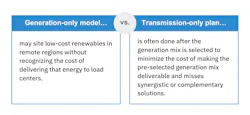
Co-optimization resolves this by internalizing the trade-off: co-optimized capacity expansion can determine, for example, whether it is cheaper to build solar closer to load at a higher levelized cost or to build in a superior resource zone and invest in a new transmission path (see Figure 2). Over a 15 to 20-year horizon, where compounding misallocations can magnify planning errors, this integrated view is essential. The result is a portfolio that minimizes total system cost (capital, fuel, operations, and transmission) rather than minimizing component costs in isolation that may be globally suboptimal.
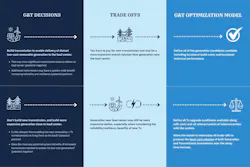
Furthermore, co-optimization captures the synergies between resource diversity and transmission. A well-planned transmission network enables geographic diversification of variable renewables, potentially reducing the need for expensive storage or peaking capacity. These interactions are invisible to a siloed planning process.
Further Complications in CEM
Zonal vs. Nodal Representation: Pragmatism Meets Precision
The spatial granularity of the network model is a defining tension in long-term Capacity Expansion Model design. Nodal models represent every bus, line, and contingency in the transmission network, yielding the most physically accurate power flow representation. However, the combinatorial explosion of investment candidates across thousands of nodes and dozens of time periods renders full nodal co-optimization computationally intractable over 15 to 20-year horizons.
- Key Point: Zonal models, by contrast, aggregate the network into manageable regions connected by transfer limits—sacrificing intra-zonal precision but making co-optimization practical. A promising middle ground is a “reduced network” approach, which simplifies the nodal topology while preserving key electrical characteristics.
Co-Optimization Provides Sharper Investment Signals
As the grid undergoes rapid structural change, jointly planning generation and transmission is no longer a modeling preference but a strategic imperative. Independent planning approaches routinely lock in inefficiencies such as siting low-cost renewables far from load without accounting for delivery costs, or reinforcing transmission paths that become misaligned with future supply patterns. Co-optimization corrects these distortions by internalizing systemwide tradeoffs and identifying investments that minimize total, rather than siloed, costs over multidecade horizons.
Co-optimization of G&T necessarily requires greater topological granularity to ensure that important transmission paths are being modelled. Planning frameworks that co-optimization with zonal or reduced-network spatial approaches strike the right balance. The objective is to maintain computational feasibility while preserving the operational realities of a variable, weather driven grid. Utilities should ensure that planning models include sufficient topological granularity to capture critical power transfer corridors so that co-optimization can deliver results more robust than analyzing generation and transmission separately.
For decision-makers, the takeaway is clear. Co-optimization:
✓ Provides sharper investment signals, with comprehensive models that take endogenously includes the trade-off between generation and transmission.
✓ Reduces the risk of costly over or underbuilds, especially when executed by a team that has experience in these areas.
✓ Supports a more reliable and economically efficient expansion of critical power systems.
Adopting this integrated approach ensures that long-term infrastructure choices remain aligned with both system needs and the evolving dynamics of the energy transition.
1. NERC – Long Term Reliability Assessment.
2. Annual Energy Outlook 2025 - U.S. Energy Information Administration (EIA).
Sponsored by:

About the Author
 Conrad Fox
 Conrad Fox
Principal Engineer, EPE
Conrad Fox is an accomplished engineer specializing in resource planning, energy economics, decarbonization, and electricity market analysis. He leads the development of advanced models for capacity expansion and energy storage and plays a key role in designing capacity market mechanisms. His experience includes creating dynamic demand response algorithms, managing real-time operations, integrating wind and storage into electricity markets, and establishing the Integrated Resource Planning process at a major North American ISO. Conrad has a robust understanding of electricity markets, policy implications, and power system modeling, encompassing capacity expansion, energy dispatch, and renewables integration. He effectively communicates complex concepts through various platforms, including recent presentations at the Canada’s National Energy Modelling Hub Annual Conference.
His technical expertise includes proficiency in PLEXOS (LT-MT-ST), UPLAN, PROMOD, MATLAB, Python, R, Tableau, and Microsoft Office/Excel. His quantitative skills in economic and financial analyses, power system optimization models, and statistical forecasting have been demonstrated through numerous public and confidential reports and projects. Conrad is a founding member of the Canadian Energy Modeling Hub, actively participates in ESIG working groups including the FERC 1920 Benefits calculation task force. He is also fluent in English and French.