Woodpecker Damage: An Overlooked Threat to Pole Reliability
Key Highlights
- Woodpecker damage to wooden utility poles is increasing, leading to higher replacement costs and operational challenges for utilities.
- Strategies such as replacing wooden poles with metal or concrete, installing physical barriers, and using behavioral deterrents are employed to mitigate damage.
- Enhanced inspection methods and predictive modeling help utilities identify high-risk poles, enabling targeted maintenance and risk management.
- Population growth of woodpecker species and habitat changes contribute to the expanding geographic scope of damage incidents.
- Addressing this issue requires a balanced approach that considers wildlife protection, infrastructure resilience, and cost-effectiveness.
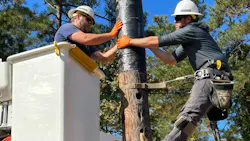
Woodpecker damage to wooden utility poles is an emerging infrastructure concern for utilities in North America, Canada, Europe and beyond. Although wooden poles remain a cost-effective and widely used structural asset, increasing evidence from recent utility experience shows that damage caused by woodpecker activity can accelerate structural degradation, prompt premature replacements, and impose measurable financial burdens on maintenance and reliability programs.
Recent utility case examples and industry data illustrate the ongoing financial impact and the operational responses being developed to address this risk.
Utility Examples
Snohomish County PUD, Washington: In 2024 Snohomish County Public Utility District reported a project costing roughly $1.5 million to replace 19 wooden poles, all but one of which were taken out of service due to bird and insect damage, with woodpeckers identified as a primary factor in much of the pole degradation. The replacement work involved switching to metal poles in the affected section to improve reliability and safety. The utility noted that routine inspections inform decisions to repair or replace deteriorated poles as part of its overall pole asset program.
Hydro-Québec (2012–2021): Hydro-Québec documented more than 100,000 poles with woodpecker damage over the 2012 to 2021 period, with roughly 12,000 poles requiring replacement due to severity of damage. The utility reported that woodpecker activity had become the second leading cause of pole replacement after age, and that damage was appearing in areas previously unaffected. Replacement costs were noted at about $5,500 or more per pole, depending on equipment and access, according to Radio-Canada.
Drivers of Increasing Damage Incidents
Evidence from utilities and operational analyses suggests that instances of woodpecker damage are becoming more frequent, although the trend is uneven and the quality of recordkeeping has improved over time.
Hydro One in Ontario notes that woodpecker activity contributes to pole degradation observed during its annual pole testing and inspection programs, with damage recorded as part of its condition assessment processes. Hydro-Québec has stated that areas once unaffected are now seeing significant woodpecker activity and associated damage, implying a geographic expansion of the risk, according to Radio-Canada.
Population and habitat factors support a biological basis for increased interactions with infrastructure. Historical analyses, including long-term bird monitoring studies, show significant regional increases in populations of pileated woodpeckers and other species in parts of North America, increasing the number of birds capable of interacting with poles even if individual behavior remains unchanged.
Utilities and researchers also link increased damage to changing landscapes, including second-growth forests, suburban expansion with ornamental trees, and continued reliance on wooden poles, which collectively create abundant substrates for foraging, drumming, or nesting near power lines.
Beyond utility infrastructure, building sector research notes that woodpecker strikes on exterior building cladding have grown in some suburban and urban areas, further illustrating expanding interactions between woodpeckers and human structures.
Is the Increase Real or Perceived?
Some portion of the apparent increase in reported woodpecker damage reflects improved inspection and reporting. Modern pole condition surveys, more structured logging of damage causes, and greater data sharing with researchers mean that incidents that might have been overlooked in past decades are now formally captured and categorized.
Nevertheless, explicit statements from utilities such as Hydro One and Hydro-Québec regarding increased damage, along with documented pole replacements driven by woodpecker activity, provide evidence of a genuine upward trend in at least parts of North America.
Solutions for Utilities
Utilities employ a portfolio of mitigation and management strategies to address woodpecker damage, balancing cost, reliability, wildlife protection, and long-term resilience.
Pole Replacement with Non-Wood Materials
Replacing wooden poles with alternatives such as steel, concrete, or composite/fiberglass eliminates susceptibility to woodpecker damage. These poles often provide decades of service life. However, higher capital costs and installation complexity mean this approach is typically reserved for critical corridors, repeated problem areas, or broader grid hardening programs.
Pole Reinforcement, Physical Barriers and Structural Repair
Physical wraps, shields, mesh, and jackets provide a barrier that prevents woodpeckers from accessing the wood surface. Utilities may install these proactively or after initial damage. Products that create a durable protective layer can reduce further damage while maintaining structural integrity.
Solutions such as composite protective barrier systems, which are designed to extend pole life and protect against wildlife activity, are part of a spectrum of protective approaches that utilities may consider as part of grid hardening efforts.
Behavioral Deterrents
Reflective materials, visual decoys, and noise deterrents have historically been used to discourage woodpeckers, although their effectiveness tends to be inconsistent as birds habituate. Some operators deploy these tools as temporary or supplementary strategies.
Habitat and Wildlife Management
Habitat interventions, such as installing alternative nesting structures or managing forest insect populations, are sometimes pursued in coordination with wildlife agencies. Regulatory protections for woodpecker species often limit exclusionary measures, and results can be indirect.
Inspection, Monitoring, and Risk-Based Targeting
Enhanced inspection techniques such as ground surveys, drones, LiDAR, and predictive modeling help utilities identify poles most likely to fail or be attacked. Integrating these insights into asset management systems enables more targeted decision making on whether to repair, protect, or replace.
Woodpecker damage is no longer an isolated maintenance issue. For many utilities it represents a tangible infrastructure risk influencing asset management and capital planning. While improved reporting contributes to visibility, utilities’ own statements and documented replacement drivers suggest a real upward trend in damage in specific regions. Addressing this risk effectively requires a balanced portfolio of mitigation techniques tailored to local conditions, species behavior, and system priorities. Woodpecker damage should be considered alongside other natural and environmental factors in long-term reliability and grid hardening strategies.