AI-Enabled Technology Analyzes Utility Poles to Improve Reliability and Resiliency
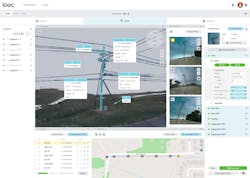
Looq AI, an exhibitor at Distributech in Booth #UL423, today announced the launch of qPole. This AI-enabled solution is designed to make the power grid more reliable and resilient by training AI models to understand utility poles the same way experienced engineers do, based on physical structure, geometry, materials and real-world context.
About the Technology
The U.S. power grid consists of an estimated 180 million to 200 million distribution poles — some aging, some in areas with extreme weather. Utilities face growing pressure to comply with state mandates for wildfire risk reduction and storm hardening.
Accurate pole data has become a critical foundation for grid reliability, yet it is still largely collected and processed using a slow, manual and inconsistent workflow. Currently, thousands of utility contract companies work around the clock to complete detailed Pole Load Analysis (PLA). Geophysical reasoning is a way to understand physical objects, such as poles, in both 2D and 3D, recognizing their location in the world and the context of their surroundings.
"We have trained the computer to look at a set of images and understand the pole’s DNA —its height, diameter, material," said Dominique Meyer, CEO of Looq AI. "It also detects critical components like crossarms and transformers — just as an experienced engineer would."
This understanding allows the system to generate an engineering-ready representation of each pole, rather than just a collection of measurements.
Field to Office: A Transformative Pole Modeling Workflow
Today, capturing pole information is time-intensive and often hazardous. Crews rely on manual fielding, hot-sticking or image-based capture to collect pole heights and pole attachments, often navigating difficult terrain, extreme weather and local wildlife, including snakes.
Field capture alone takes roughly 15 minutes per pole. Looq streamlines this process, reducing fieldwork to about two minutes per pole through a safer, reliable, and repeatable workflow.
"Looq’s AI uses this human-like understanding to create a blueprint of a CAD model for each pole," Meyer said. "It captures the data necessary to evaluate asset health, identifies current or potential future failures and clearly communicates the path to remediation."
Beyond the field, back-office processing previously added another 15 minutes per pole, as engineers manually validate data before using PLA tools like SPIDAcalc, O-Calc or PLS-CADD. The qPole AI-assisted processing is completed in about five minutes per pole and automatically detects and models each structure and its equipment.
By streamlining capture and processing from a total of 30 minutes to just 7 minutes per pole, Looq is transforming utility workflows, according to the company.
"This average saving of 23 minutes per pole represents unlocking an estimated 19 million work hours saved annually in the U.S. alone," Meyer said. "These reclaimed hours allow utilities to reallocate urgent investment toward grid hardening rather than manual data entry. In an industry facing a critical labor shortage, shifting focus ensures that maintenance backlogs are addressed without needing to increase headcount."
Field measurements are accurate to under a centimeter. This accuracy helps derive correct construction requirements, avoiding overbuilt or unnecessary projects. In many cases, poles were previously replaced at the ratepayers’ expense when accurate measurements would have confirmed sufficient structural integrity.
"EPI is excited to see the next evolution in distribution fielding with Looq AI," said Erik Kolb, PE, senior engineer at The Engineering Partners, Inc. "Our industry is primed for this exact kind of technology. We look forward to integrating our fielding practices with qPole, which will allow EPI to very quickly update its existing pole information."
Solutions like this have the potential to significantly improve how utilities approach asset modeling, safety and grid reliability, said Audra C. Drazga, president and founder of Summit Path Advisory.
"I met Looq in 2025, and it has been exciting to watch their vision evolve," Drazga, said. "I am encouraged to see how qPole delivers practical, real-world value to the industry."