Terna: Electricity Demand Rose 2.1% Percent to 25.4 billion kWh During February 2026 in Italy
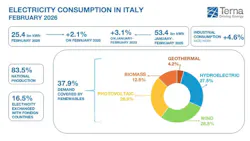
According to data published by Terna, Italy’s electricity demand increased to 25.4 billion kWh in February 2026, a 2.1% rise compared to February 2025.
Wind power was the main source covering electricity demand, with 2.8 billion kWh, exceeding both solar and hydroelectric generation. Overall, renewable energy production increased by 27.8%.
Compared with 2025, February had the same number of working days and an average monthly temperature higher by 1.1°C. When adjusted for temperature and calendar effects, the demand showed an increase of 2.4%.
Seasonally adjusted demand, (adjusted for temperature and calendar effects) decreased by 1.8% as compared to January 2026. Growth is consistent across the country: +1.8% in Northern Italy, +2.2% in the Centre, and +2.8% in the South and Islands.
During the Milano Cortina 2026 Winter Olympic Games, held from 6 to 22 February, the Primary Substations serving the Olympic areas recorded an increase in energy exchanges: +38% compared to the same period in 2025, with peaks of up to 50% on the days of the most widely attended competitions.
The result highlighted the strength and reliability of the Italian national electricity system, capable of supporting an international event while ensuring continuity and quality of service in the territories involved. To support the needs of the Games, the company invested over $344.64 million in strengthening the electricity grid in the regions concerned.
In February, the IMCEI (Monthly Industrial Electricity Consumption Index) developed by Terna, which analyzes industrial electricity use among approximately 1,000 energy-intensive industrial enterprises, recorded a 4.6% increase, marking the sixth consecutive month of growth.
Positive trends were observed in steel, non-ferrous metals, and ceramics and glass sectors. Cement, lime and plaster, paper, mechanical engineering and chemicals sectors declined, while food and transport industry remained stable.
The IMSER (Monthly Services Index), published by Terna on the basis of electricity consumption data supplied by distribution operators (E-Distribuzione, UNARETI, A-Reti, Edyna and Deval), and released with a two-month lag compared to industrial and total consumption data, showed a 3.3% increase in December 2025. For the full year 2025, the IMSER index increased by 2.9% compared with 2024.
Domestic production covered 83.5% of electricity demand; the remaining 16.5% was met through net imports. Net domestic generation totaled 21.5 billion kWh, increased by 2.5%.
The cross-border balance rose by 3.2% due to stable imports and a 37.6% decrease in exports. In February, renewable sources accounted for 37.9% of total demand, compared to 30.3% in February 2025, with overall growth of 27.8%.
Wind generation recorded a 117% increase of 1,493 GWh, mainly due to higher wind conditions (+1,414 GWh) and only partly to the increase in installed capacity (+79 GWh). Solar power showed a total increase of 526 GWh (+25.5%), supported by the growth in installed capacity (+355 GWh).
Hydroelectric recorded a more moderate increase (+5.8%), while thermoelectric decreased (-12.1%) and geothermal production declined (-2.7%).
According to Terna’s data, total installed renewable capacity increased by 559 MW in February. As of 28 February, installed capacity was at 84,562 MW, including 44,390 MW of solar and 13,781 MW of wind power. 906,082 new storage system installations were recorded in Italy, corresponding to 18,539 MWh of capacity and 7,600 MW of nominal power.