The Grid’s Missing Middle: Scaled Distributed Storage Built into the System
Key Highlights
- Distributed storage, especially front-of-the-meter batteries, can fill the critical 'missing middle' between bulk storage and customer demand response, increasing grid capacity.
- Scaling distributed batteries offers a faster, cost-effective alternative to traditional transmission upgrades, with deployment timelines of 12-24 months versus years for large infrastructure projects.
- Utilities need to synchronize planning and operations, evolve operational technologies, and actively dispatch distributed assets to maximize their value and reliability benefits.
- Programs like Xcel Energy's Capacity*Connect demonstrate successful utility-led models for deploying distributed batteries at scale, gaining regulatory and industry support.
- Integrating distributed storage requires a shift from passive to active management, leveraging advanced distribution management systems and real-time system data for optimal operation.
Our public water systems use water towers. Our natural gas systems use linepack. These distributed storage resources serve as a buffer for variability between the bulk supply and end users. In contrast, our electric grid has long operated without distributed storage embedded into the system. We take this storage for granted in other infrastructure networks—they were built with it in mind, or it came as part of the system—but the grid has to balance supply and demand in real time.
For most of the grid’s history of predictable supply and demand, that real-time approach has worked successfully, delivering safe and reliable power to the customers who needed it. Now, we’ve entered a period where demand for electricity is rapidly outpacing supply, driven by AI data centers, advanced manufacturing, and electrification. At the same time, a transition to wind and solar generation resources is shifting when energy supply scarcity is likely to occur. Many regions face the challenge of delivering enough power where and when it is needed without overbuilding infrastructure and driving up prices. Further, we aren’t using the system we already have to its full potential, creating an opportunity to unlock capacity from our existing infrastructure and increase grid utilization, while respecting planning limits associated with system contingencies (e.g., line or generator outages).
It’s time to take a cue from our other infrastructure systems and embed distributed storage at scale across the grid. With distributed batteries, we can add storage onto the distribution system as utility infrastructure, increasing usable grid capacity to help meet growing demand and ease pressure on rising rates.
Solving for the Grid’s Missing Middle with Distributed Batteries
A scaled distributed storage layer on the grid would fall between bulk storage + generation and customer demand response resources. Right now, this layer is the grid’s “missing middle.”
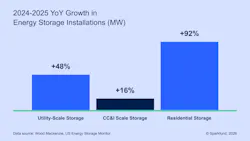
Wood Mackenzie reports that utility-scale battery storage installations grew by 48% in 2025, totaling 16,000 MW. At the same time, residential battery installs grew by 92%, reaching 2,700 MW. However, mid-size community, commercial, and industrial (CC&I) batteries grew by only 16%, with 191 MW of storage capacity installed. There is significant untapped value in that middle layer.
Distributed, front-of-the-meter (FTM) batteries in the 1–3 MW range are well suited to fill this gap. They align with feeder and substation-level needs and are large enough to meaningfully contribute capacity to meet bulk system needs. Additionally, FTM distributed storage complements transmission-level, utility-scale storage and behind-the-meter (BTM) residential batteries by right-sizing resources across different layers of the system. Having resources at every level is becoming essential to manage reliability and service quality.
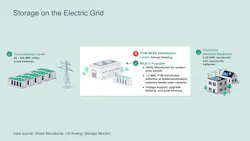
Deploying these assets at scale would add capacity, relieve local constraints, defer grid upgrades, and improve the utilization of existing infrastructure without requiring large-scale transmission buildout. In many cases, targeted distributed storage can be deployed in 12–24 months compared to the 5-10+ years required for major transmission projects.
One way we can scale up the missing middle layer is through distributed capacity procurement, a utility-led model for deploying FTM batteries on the distribution grid as core infrastructure. Xcel Energy is already implementing the distributed capacity procurement model in MISO through its Capacity*Connect program, which was approved by the Minnesota Public Utilities Commission and will deploy 200 MW of FTM batteries on the distribution grid over three years. The program reflects growing recognition among regulators, utilities, and hyperscalers that distributed storage can serve as a core reliability and capacity resource.
As the industry faces rapid load growth and the reliability challenges that come with capacity scarcity, it now has both the technology and a deployment model to deliver a more distributed, flexible, and reliable grid.
A Practical Path Forward: Making FTM Distributed Batteries Work at Utility Scale
Historically, utilities planned around a small number of worst-case peak hours, but as renewable generation grows, system risk is becoming more dynamic and less predictable. Risk is now spread across more hours of the day and is shifting over time. The combination of growing power demand and more variable system conditions puts increasing pressure on grid infrastructure. Distributed batteries can help address this challenge by responding flexibly to system conditions and enabling a more adaptive, resilient operating model.
Utilities have visibility into and control of system topology and constraints, making them a natural fit to plan and operate FTM distributed batteries, just as they would any other core grid infrastructure. For instance, an Advanced Distribution Management System controlling active power output of a portfolio of batteries on a substation, coupled with real-time information on system loading constraints, allows batteries to be a planning-grade asset to support distribution feeder loading during abnormal operations (i.e., N-1 contingencies). However, successfully integrating distributed batteries and capturing their value requires utilities to move beyond passive approaches and toward more active, coordinated dispatch of assets.
Realizing this opportunity at scale requires utilities to focus on a few critical areas:
Synchronize planning and operations
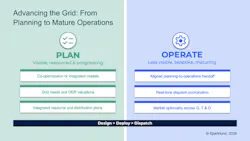
Planning and operations have traditionally operated as separate functions within a utility, but the active participation of distributed assets in system reliability will require closer coordination between the two. Planning assumptions must increasingly reflect operational realities, and operational capabilities must be designed to capture planned value.
Balance market participation and distribution grid needs
Distributed batteries can deliver value in both wholesale markets and on the distribution system. Doing so requires thoughtful coordination, and utilities must consider trade-offs in the need for managing local system constraints and accessing market revenues. Accessing wholesale-market products means accepting trade-offs against distributed resource flexibility, and the ideal positioning is based on the specific grid needs and values (i.e., use case).

Evolve and integrate operational technology over time
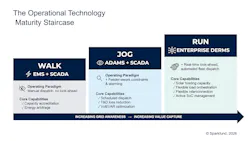
Utilities do not need fully advanced systems to begin capturing value from distributed batteries. They can take a "walk, jog, run" approach, starting with existing dispatch capabilities via distribution SCADA and communication systems, and progressively adding more sophistication as driven by the use cases. As a utility’s operational capabilities mature—from basic substation visibility to feeder-aware constraints to automated dispatch with enterprise DERMS—it can deliver more value.
Utility-grade Distributed Storage is Ready to be Built
Distributed batteries are a deployable, scalable resource that can address capacity shortfalls quickly for the benefit of customers, utilities, and the broader system. While integrating these batteries at scale requires new ways of planning and operating the grid, there is a path forward.
Utilities that begin this transition now can capture value early while building the capabilities needed for a more dynamic energy system. If the industry starts building up the “missing middle” today, we’ll soon have a bridge to meet the next wave of electricity demand.
About the Author
Patrick Dalton
Patrick Dalton is Director of Systems Engineering at Sparkfund.