The Cooperative Difference: How Vegetation Management at Rural Electric Cooperatives Requires Its Own Playbook
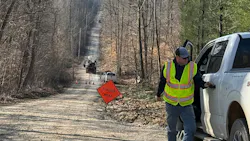
When an electric cooperative member calls the home office about the oak tree her late husband planted 30 years ago, she expects someone who knows her name to pick up. She is not submitting a ticket. She is not waiting for a callback from a regional service center. She is calling the office, and she expects a real conversation with someone who knows her property, understands what that tree means and can tell her exactly what is going to happen.
The coordinator who takes that call also knows there is a contractor behind schedule on the east side of the territory, a circuit flagged after last week's outage that needs to be reprioritized and an annual inspection report due to the board next month. That is a Tuesday at an electric cooperative, and it is the starting point for understanding why vegetation management at a co-op is a fundamentally different discipline than anywhere else in the utility industry.
The frameworks, tools and workflows that work at large investor-owned utilities often fail at cooperatives, not because co-ops are less sophisticated, but because those frameworks were never designed for the specific realities of the cooperative model. Understanding those realities is the prerequisite for building programs that actually work.
Fewer Handoffs, Faster Decisions
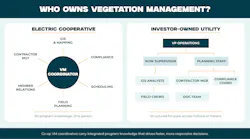
At a large investor-owned utility, vegetation management moves through a defined chain: a circuit gets flagged, routed to planning, scheduled by a supervisor, executed by a contracted crew and documented by a separate team. Each role has a narrow scope. The structure is built to manage millions of meters across multiple states, and it works because the scale demands it.
There is an old adage in the cooperative industry: if you have seen one co-op, you have seen one co-op. A larger cooperative might have a dedicated VM team with defined roles. A smaller one might rely on a single coordinator who handles everything from GIS mapping to contractor management to member calls. What those models share is something the IOU structure rarely offers: the people doing the work carry integrated, end-to-end knowledge of the program.
That integration is a structural advantage. Whether program knowledge lives in one person or within a small team, information does not get lost between handoffs. The person who knows the member also knows the circuit, knows the contractor and knows exactly what tradeoffs are on the table. Decisions happen faster, adjustments happen closer to the ground and the program remains responsive in ways that a layered departmental structure makes difficult by design.
Tools and workflows built around IOU handoff models (requiring separate data entry at each stage or role-restricted access to information) introduce friction that undermines this advantage rather than supporting it.
Planning on the Fly, on Purpose
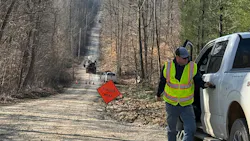
A co-op coordinator building a trimming schedule in January works from outage data, growth condition reviews and a circuit-by-circuit prioritization. By April, that plan looks different. A wet spring pushed growth rates on two feeders faster than projected. A member on Rural Route 4 has been calling about a sycamore moving toward the line ahead of schedule. The contractor assigned to the north end of the territory pushed their start date back three weeks.
The coordinator adjusts, moves things around, makes a few calls and the schedule reflects reality again before lunch. No formal approval chain. No replanning process. Just someone with complete program knowledge making a judgment call and acting on it.
That responsiveness is not a workaround for a broken process. It is how cooperative vegetation management is designed to work, and the best programs are built around it. Rigid scheduling systems that require change orders or supervisor approvals for routine adjustments are not just inefficient in this environment; they actively undermine the program.
The Member on the Other End of the Phone
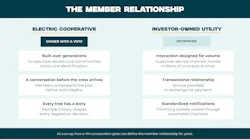
At an investor-owned utility, a member with a tree concern is a ratepayer with a service issue. It gets logged, routed and handled through a customer service channel built for volume. The interaction is designed to be efficient.
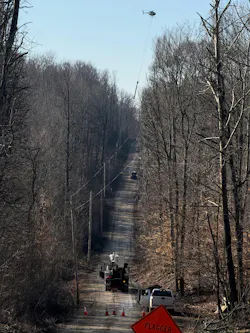
At a cooperative, that same call is something different. The member is an owner with a vote, often a decades-long relationship with the cooperative, and a personal history with the land the crew is about to work on. When line crews show up near a property, they are not just a utility contractor. They are a representative of an organization the member has a direct stake in.
Coordinators at effective co-op programs do not treat member communication as a workflow step. They treat it as a core operational function, one that shapes whether the physical work gets done right.
A member who understands what is happening and why will cooperate with access requests, accept difficult decisions about tree removal and extend goodwill when work runs long. A member who feels uninformed or dismissed will not. Programs that reflect this reality build notification and member contact into the workflow itself, not as an afterthought.
Protecting the Tree While Protecting the Line
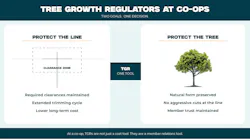
Tree growth regulators (TGRs), compounds that slow crown development by suppressing the plant hormone responsible for cell elongation, are increasingly part of the co-op VM toolkit, and the reasoning goes beyond the trimming cycle math.
An IOU evaluating TGRs runs a cost model: fewer cycles over time, weighed against upfront application cost across a circuit. The calculation is financial.
A co-op coordinator running the same analysis is also thinking about the member. The mature oak near the line in Section 7 belongs to a family that has farmed that ground for three generations. Taking it back hard to maintain a clearance cycle creates a relationship problem that outlasts the trimming visit by years.
TGRs allow coordinators to maintain required clearances without making cuts that generate lasting grievances, protecting the infrastructure and the member relationship at the same time. When that decision gets explained to the member directly, it lands differently than any outage statistic ever could. That is not a soft consideration. It is the kind of decision-making that cooperative programs run on.
Cooperation Among Cooperatives
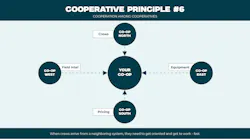
When a major storm rolls through and knocks out service across half a cooperative's territory, mutual aid agreements activate within hours. Crews from neighboring systems load up and head toward the damage, a practice grounded in Cooperative Principle #6, Cooperation Among Cooperatives, and supported by agreements in place for decades.
As Shaun Lamp, president and CEO of Great Lakes Energy, explains, "That same ethic shapes how co-ops share vegetation management knowledge. Coordinators compare contractor performance through state associations, coordinate on pricing and talk through what they are seeing in the field. Knowledge in the cooperative movement is treated as something to share, not protect."
He said mutual aid also creates a specific operational requirement that often goes unacknowledged in program design. When a crew arrives from two states away after driving through the night, they need to get oriented and productive immediately. Programs and documentation systems that outside crews can navigate without a dedicated orientation meeting are not just convenient; they are a practical expression of what mutual aid actually demands in the field.
"During a recent catastrophic ice storm, we had staff from every area of the co-op stepping in wherever they were needed, whether that meant working in the warehouse, preparing materials, or even making meals for the crews," he said. "I could walk around the office and never knew who I would see, where I would see them or what role they would be filling, but everyone showed up with the same attitude: whatever needs to be done, we are here to do it and get the power back on for our members.
And what really stood out was the support from other co-ops across Michigan. They showed up in a big way, sending line crews, office staff and support teams into our facilities. That level of cooperation and willingness to help is what truly defines co-ops."
Why This Matters
Co-op vegetation management programs that have seen the most measurable improvement in reliability, cost control and member satisfaction share a common characteristic: they stopped trying to adapt IOU frameworks to a cooperative context and built around co-op realities instead.
The implications are concrete. Staffing models should reflect integrated program knowledge rather than siloed roles. Scheduling tools should support rapid, judgment-based adjustments rather than formal change processes. Field tools must function without a data connection. Member communication should be treated as a core operational function, not a courtesy. And every technology investment should be evaluated against a single practical question: does this make the coordinator more effective, or does it add administrative overhead a lean program cannot absorb?
The approximately 900 rural electric cooperatives in the United States represent a significant share of the nation's distribution infrastructure, and they operate it with staffing levels that would be unrecognizable at comparable IOUs. Programs designed specifically for that environment are not a niche interest. They are an operational necessity for the cooperatives that have always kept power flowing where no one else would go.
About the Author
Pablo Fuentes
Pablo Fuentes is co-founder and CEO of Bloom Spatial, a vegetation management platform built for electric cooperatives headquartered in Bloomington, Indiana. Fuentes serves as a field volunteer with the Monroe County Community Emergency Response Team and is co-founder and president of Cosmic Songwriter, a non-profit organization. He holds a BA from UCLA and a Master’s in Business Administration from Stanford University. He can be reached at [email protected].