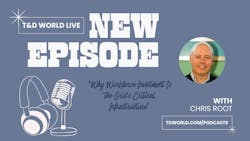
T&D World Live Podcast: Why Workforce Investment Is the Grid’s Critical Infrastructure
Listen Now!
In this episode of the T&D World Live podcast, we speak with Chris Root, former Chief Operating Officer of Vermont Electric Power Company (VELCO) and current industry advisor at Danovo (formerly Quanta Technology).
The conversation previews the upcoming TechCon conference in Puerto Rico, hosted by H2B, and explores the broader workforce and infrastructure challenges reshaping the electric power industry.
Root explains that TechCon has been held in North America for more than 30 years and focuses heavily on substation equipment, transformer maintenance and protection systems. Unlike purely academic engineering conferences, TechCon combines technical papers with practical, hands-on training sessions. Engineers, managers and technicians attend not only to hear about emerging research but also to participate in applied workshops on transformer monitoring, load tap changers and protection systems.
A distinguishing feature of the conference is its accessibility to both engineers and field personnel, creating opportunities for cross-functional learning. Root emphasizes the value of in-person events, where professionals can exchange real-world solutions and discover issues they may not yet recognize in their own systems.
He shares a notable example from a previous TechCon: premature transformer failures at wind farms in Spain. Distribution-class transformers, not designed for the variable power output associated with wind generation, were experiencing insulation breakdown due to electrical pulsing. Because these sealed transformers were not routinely monitored, the problem went unnoticed until failures occurred. Root notes that this insight — rarely discussed in other forums — sparked ongoing industry dialogue and highlights the practical knowledge-sharing that defines the conference.
Spotlight on Workforce Development
A major focus of Root’s TechCon panel will be workforce development, particularly the pressing question: “Where are the engineers going to come from?”
He outlines the participation of three panelists:
-
Mark McVeigh (Dominion Energy) – A senior technology leader and IEEE Fellow who will discuss Dominion’s expanding university partnerships and innovative approaches to recruiting engineers and technical talent.
-
La Rhonda Julian (Georgia Transmission Company) – Offering perspective on competing for engineering talent in regions where multiple utilities operate.
-
Dr. Carlos Cardona (LUMA College, Puerto Rico) – Leading a training institution created to rebuild and sustain Puerto Rico’s utility workforce after Hurricane Maria, with strong partnerships across local universities and a focus on developing in-island talent.
Root explains that LUMA essentially had to rebuild its workforce from scratch, turning over roughly 80% of staff when the organization was formed. In response, the company created structured training programs and internship pipelines to cultivate local talent and reduce reliance on external recruitment.
A Perfect Storm of Demand
The workforce challenge, Root says, is not new — but it has intensified. The industry faces:
-
An aging utility workforce
-
Accelerated capital spending
-
Electrification of industry
-
Rapid expansion of data centers
-
Increased competition for electrical engineers from tech companies like Google and Amazon
Data centers in particular have dramatically shifted the demand landscape. These facilities consume electricity at the scale of small cities, requiring extensive engineering design, substations and system reinforcements. Meanwhile, consulting firms and technology companies are competing directly with utilities for power system engineers.
Root notes that while renewable energy initially attracted many students into power engineering programs, the rise of AI, data centers and advanced technologies has broadened both the opportunity set and the competitive pressures.
Education, Technology and Evolving Skill Sets
The conversation also examines whether traditional education pathways are sufficient for the future grid. Root believes engineering education is evolving to incorporate new technologies like AI, which may accelerate learning and enable more technically capable roles for those without full four-year engineering degrees.
At the same time, he highlights a growing gap in practical mechanical skills among incoming workers. With fewer young people gaining hands-on experience using tools, utilities increasingly must provide foundational training for technicians and lineworkers.
This shift underscores the need to rethink both technical education and workforce preparation to align with modern realities.
Purpose and the Social Impact of Power
Root also discusses the importance of purpose in attracting younger professionals. Many entering the workforce seek careers that have social impact. Root argues that few industries offer as much societal value as electric power — providing refrigeration, heating, communications and essential services that underpin modern life.
Natural disasters and major outages reinforce this reality, putting the industry in the public spotlight and reminding communities of electricity’s critical role.
Investing in People as Core Infrastructure
Root concludes with a strong message: utilities must treat workforce investment as seriously as equipment investment.
He emphasizes:
-
Supporting employee development
-
Funding attendance at industry conferences
-
Encouraging knowledge exchange
-
Recognizing frontline workers and engineers as core infrastructure assets
In-person events like TechCon, he argues, enable learning that cannot be replicated through webinars or documents. They expose professionals to new problems, new solutions and new perspectives — often before those challenges emerge in their own organizations.
T&D World Live Now on YouTube!
About the Author
 Christina Marsh
Christina Marsh
Senior Editor
Christina Marsh is senior editor of T&D World at Endeavor Business Media (EBM), responsible for managing, editing, and contributing to the print issue production in addition to e-newsletters and digital content including podcasts. Previously, Christina was editor of Airport Business at EBM where she was responsible for contributing editorial support for the magazine, writing and compiling e-newsletters as well as contributing to digital content including producing video and podcasts. Before working with EBM, Christina was a multimedia journalist and podcast producer at The Experimental Aircraft Association (EAA). She graduated with a B.S. in journalism from the University of Wisconsin Oshkosh.