Ocala Electric Helps Customers Beat Back Bills with Prepay
Key Highlights
- Ocala's prepay program allows customers to pay as they go, avoiding deposits and reducing debt gradually, which benefits financially vulnerable residents.
- The deployment of AMI and MDM systems has enabled real-time usage tracking, alerts, and proactive maintenance, saving approximately $170,000 annually.
- Nearly 15% of Ocala's customers participate in prepay, using 6.4% less energy than postpay customers, with even greater savings during peak demand hours.
- Future initiatives include integrating energy disaggregation technology to provide device-specific usage insights and personalized energy-saving tips.
- The program emphasizes customer engagement and education, leading to high satisfaction rates and more efficient energy consumption across the community.
The City of Ocala, Florida is almost in the dead center of the state, about an hour and a half drive northwest of the town with the big theme parks. About 64,000 people live there — up almost 13% since the last census. The poverty rate is substantially higher than the national average, and in Florida generally residents saw electric rates rise 10% in the past year.
Ocala, and its municipal utility, Ocala Electric Utility (OEU), care about the cost of the vital services they provide. In 2010, city leadership heard about the voluntary prepay service and decided they wanted it for their customers.
This was about a year after Ocala had deployed its Advanced Metering Infrastructure (AMI) system. At the time, the business driver for prepay was customer debt, which had climbed into the millions by then. Ocala decided to work with prepay provider Exceleron, using that company’s MyUsage prepay platform in what would become one of the oldest modern prepay programs in North America.
How It Works
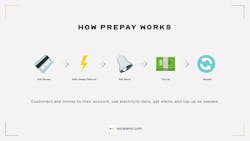
With prepay, customers don’t receive a bill for a month’s worth of usage. Instead, they pay into a credit balance — as much and as often as they like. Each day, as they use energy their balance is decreased by the daily cost. Payments immediately “top up” their balance. Frequent alerts tell customers how much they have left before they need to make a payment. If service stops after they’ve exhausted their funds, a minimal payment can restore it. And if they were past due when they enrolled, they can reduce their arrearage gradually over time with a percentage of each new payment they make; Ocala chose 20% as the “debt recovery” share.
Prepay promises complete avoidance of new debt, and no need for security deposits or disconnect/reconnect fees — all major benefits for Ocala’s customers. And prepay customers employ those frequent usage and cost alerts to better manage their residential energy and in aggregate reduce consumption between 5% and 14% nationally.

Success Stories
After its AMI network went live, Ocala turned to working with Exceleron to stand up the new prepay system. It launched in 2011, with a small pilot of about 25 employees. Soon afterward, the project leaders learned about a customer, Theresa Cavanaugh, who was facing a very tough financial situation. They decided to let her enroll, becoming the first non-employee in the program.
“It gave me the ability to be able to move into my new residence which, without this program, I would definitely would not have been able to accomplish,” Cavanaugh relates in an interview she did about the new Pay As You Go program. “There’s no doubt in my mind that I would not be living here had the City of Ocala not permitted me to join this power program.”
Beyond the waived deposits and gradual debt paydown, Cavanaugh found the program awakened her to ways to save energy at home. “Every single day I look at that [prepay] report and it’s like, ‘Oh, wow, I spent an extra 50 cents yesterday; I’m going to turn that fan off.’ It sounds silly, but you really start thinking about those things.”
Almost immediately customers started seeing the benefits. Ocala in 2008 had locked in gas prices as they were rising. But then they started falling, briefly leaving the utility with among the highest rates in Florida. But prepay customers like Theresa Cavanaugh could watch their usage more closely, and take reasonable steps to reduce it.
The implementation process went smoothly, with seamless integrations into Ocala’s PeopleSoft customer information system (later updated to their current Cogsdale CIS). The biggest challenge was the need to obtain AMI usage data to send to Exceleron. Ocala had no meter data management (MDM) system at the time, and sent the data in XML files to Exceleron, which did the work of validating and “scrubbing” the data to make the daily rate calculations.
Moving to MDM
The next project was to work with Exceleron to build the utility’s first MDM system in 2012. Ocala still uses that system today, and almost immediately they began to track the cost savings from the alerts the system generated to flag problems as they emerged.
In 2024, proactive monitoring and maintenance helped prevent issues on the OEU system and at customer homes, resulting in an estimated total savings of approximately $170,000 for both customers and the City.
Today, nearly 15 years after launching their Pay As You Go program, Ocala is still looking to innovate. Exceleron is working to help Ocala become one of the first to integrate energy disaggregation into its prepay program later this year. With “disagg” they’ll use proprietary algorithms to break down a customer’s energy usage by device. Then personalized alerts will tell customers how they can extend their “days remaining” by addressing specific energy users in the home.

Piloting New Solutions
The new disaggregation pilot with Exceleron will help customers isolate energy uses in the home and conserve even more. A pilot will run for six months and include 50 prepay and 50 postpay participants. They’ll use the MyUsage app for communication, and offer daily disaggregated energy use reporting at the device level and appliance level, to produce personalized energy saving tips for the coming week.
Ocala’s hypothesis is that the supercharged engagement that prepay users have will leverage the power of disaggregation to help customers save even more energy, and add to other efforts to relieve pressure on the grid.
Similarly, the higher level of engagement is expected to boost Ocala’s efforts to encourage customers to shift usage away from times of peak demand, usually the hottest afternoon hours in the summer when the entire system is experiencing its greatest strain.
In the past year, Ocala’s roughly 7,400 prepay customers, representing almost 15% of its 59,000 customers, used 6.4% less energy than their postpay counterparts. They’ve become part of a national group of prepay customers that collectively use nearly 9% less energy – and 10% less during times of peak demand, according to Exceleron data.
Nationally, satisfaction with prepay programs exceeds 90%, according to surveys by the information and research firm E Source. Ultimately this is a customer service, Ocala maintains. It’s about conservation and giving customers the tools to manage their usage more efficiently.
About the Author
Chad Lynch
Chad Lynch is Deputy Director at Ocala Electric Utility, where he started nearly 26 years ago as a draftsman in the engineering department. Among other efforts, Lynch led the projects to implement Ocala’s geographic information system (GIS), its Outage Management System, and an Interactive Voice System (IVR). He also helped implement Ocala’s MDM system, and its “Pay As You Go” prepay program.
David Conn
David Conn is Vice President of Business Development and Policy at Exceleron, the leading provider of utility prepay service and related payment services. Before joining Exceleron in 2024, Conn served for nearly 16 years as Energy Assistance Program Manager at Baltimore Gas and Electric Co., where he led a prepay pilot program in 2020. Before BGE Conn was a nonprofit lobbyist, and a business journalist at several newspapers.