Bridging Regional Grids: DOE's Energy Dominance Financing Commits $2.8B for 106-Mile Wyoming Intertie Transmission Project
The U.S. Department of Energy’s (DOE) offices have been committing billions of dollars this year for transmission infrastructure projects across the broader Wyoming region.
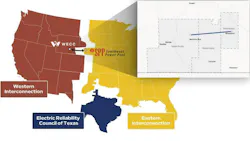
Most recently, DOE’s Office of Energy Dominance Financing (EDF) announced this week a conditional loan commitment of up to $2.8 billion for Grid United's Wyoming Intertie project. The Houston-based independent transmission company reportedly pitched the Wyoming Intertie project in 2022. It is an approximately 106-mile, up to 1,800 MW, high-voltage direct current (HVDC) transmission line project proposing to connect the Eastern and Western Interconnection grids.
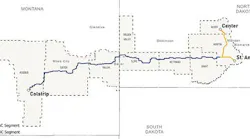
The proposed line would extend through Carbon, Albany and Platte counties in Wyoming, with endpoints in Carbon County and Platte County, according to Grid United. By adding roughly 1.8 GW (1,800 MW) of grid capacity, U.S. and project officials estimate the Wyoming Intertie would deliver up to $39 billion in electricity cost savings.
Those potential savings, according to the EDF, would benefit American families and businesses across 17 states within the Western Electricity Coordinating Council (WECC) and Southwest Power Pool (SPP) regions. Both oversee regional bulk power system reliability, with WECC enforcing standards in the West and SPP managing grid operations and wholesale markets more broadly across the central U.S.
The Wyoming Intertie project would reportedly double existing transfer capacity between the SPP and WECC regions, allowing more electricity to flow across Wyoming to meet growing demand and improve grid resilience during peak usage and extreme weather over the project’s 30-year lifespan.
According to Grid United, permitting is anticipated to wrap up around 2029, with construction expected to begin in 2030. Commercial operation is being targeted for 2032 or 2033.
In a statement, EDF director Gregory A. Beard noted the organization is financing major projects designed to deliver real benefits to American families and businesses.
“Wyoming Intertie is a prime example of how EDF’s financing can help lower electricity costs, create American jobs, and support long-term economic growth in Wyoming and across the nation,” Beard said.
As part of EDF’s loan funding terms, Grid United's Wyoming Intertie project must satisfy certain technical, legal, environmental and financial conditions before the department enters into definitive financing agreements.
While DOE’s EDF is focusing on backing Grid United's efforts to build new long-distance lines, a separate DOE initiative is targeting existing major regional infrastructure within the same corridor. In October, a similar commitment under DOE's Office of Electricity advanced federal grant funding to NorthWestern Energy.
The electric and natural gas utility provider is receiving this funding through the office’s new $5.25 billion Speed to Power through Accelerated Reconductoring and other Key Advanced Transmission Technology Upgrades (SPARK) program. The federal initiative will bolster 31 grid-improvement projects across 26 states.
NorthWestern Energy’s Montana-Wyoming Transmission Corridor project aims to boost transfer capacity between the two states along existing southeast Montana power lines. Supported by SPARK funding, the project will deploy grid-enhancing technologies (GETs), such as smart flow-control and line-monitoring tools, to relieve grid constraints more efficiently—without building new infrastructure.
Lowering electricity costs and strengthening grid reliability across the Wyoming–Montana region through both DOE offices has become a key target for future growth across the U.S. power grid.
About the Author
 Eric Moody
Staff Writer
Related
 Dreamstime L 62515976