Seeing the Unseen: Why Thermal Detection is the Next Frontier in Grid Resilience
Key Highlights
- Thermal anomalies serve as early warning signs of potential equipment failure, allowing for preventative maintenance before visible damage occurs.
- Drone-based thermal imaging expands inspection capabilities, especially in remote or hazardous areas, providing rapid and comprehensive data collection.
- AI integration automates anomaly detection and prioritization, enabling more efficient and targeted maintenance efforts.
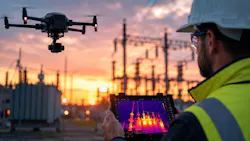
A transformer hums on the edge of a substation on a sweltering summer afternoon. But not all signs of failure can be seen with the naked eye. To an inspector walking past, everything seems normal – there’s no visible signs of damage, the equipment housing is intact, and control dashboards report no alarms. But inside, insulation is weakening, a cooling fan struggles, and heat builds. Slowly, quietly, then all at once, internal temperatures will spike beyond thresholds and the transformer will fail, triggering customer outages, costly repairs, and further strain on an already fragile network.
This isn’t just a nightmare scenario at one substation; it’s an everyday possibility at the more than 79,000 substations across the United States. Thermal anomalies are among the most common early indicators of equipment failure across the power grid, yet they often go undetected until they escalate. As climate volatility intensifies and energy infrastructure ages, these hidden thermal signatures are becoming more frequent, and more consequential.
More Than Just a Hot Spot
Traditional visual inspections remain an essential part of infrastructure maintenance, but they can’t reveal what is changing or worsening beneath the surface. It’d be like if we tried to predict volcano eruptions by simply looking at them. Similarly, by the time discoloration, cracking, or mechanical wear on an asset is noticeable, the underlying problem has generally progressed far beyond prevention.
Thermal anomalies provide deeper insights, revealing stress at the earliest stages before physical deterioration becomes visible. In other words, a thermal anomaly indicates more than just heat; it signals the beginning of a failure curve, one that becomes costlier and more disruptive the longer it goes unaddressed.
An Early-Warning System for the Grid
Once considered a specialized, periodic inspection technique, thermal imaging has evolved into a core diagnostic layer that helps utilities confront rising load profiles, aging assets, and more dynamic operating conditions. Electrification trends (from EVs to electrified industrial processes) are pushing equipment closer to thermal limits, and analysis from Deloitte shows peak demand is only growing – projected to rise 26% by 2035. At the same time, distributed energy resources (DERs) introduce new power flows that add complexity to grid management and asset loading.
These challenges have led many utilities to increase condition-based monitoring, relying on thermal data paired with geospatial and real-time analytics. This shift reflects a recognition that thermal signatures offer insight into how the grid is behaving, not just how it appears. This is especially powerful when aerial drones equipped with high-resolution thermal cameras are deployed, enabling rapid data capture in places that are remote, dangerous, or otherwise inaccessible. During heatwaves, wildfire risk periods, or post-storm recovery operations, thermal imaging expands the scope of analysis, providing immediate, real-world evidence of system stress and performance. It’s both diagnostic and predictive, a storm-hardening solution that offers operators earlier foresight than conventional monitoring methods alone.
Three Critical Areas for Thermal Application
Thermal detection plays a distinct role across the energy ecosystem, and three areas stand to benefit most from increased adoption: transmission and distribution (T&D) networks, substations, and renewable energy assets.
In T&D systems, thermal imaging can identify overheating connectors and pole-mounted transformers, fatigued conductors, or degrading insulators that may otherwise appear normal. It’s also invaluable after severe weather events, when crews need to know which energized components are compromised, enabling faster, safer restoration decisions. The 2024 hurricane season was one of the most destructive in US history, causing an estimated $500 billion in damage and reinforcing the urgency of modernized response tactics using thermal data.
At substations, thermal monitoring offers continuous insight into components like insulators and transformer bushings. It can detect thermal anomalies – conditions that, if ignored, will lead to failure.
Solar farms present another compelling application. Thermal patterns can reveal module-level issues within solar farms like PV panel issues, cracks or dirt that degrade performance over time, and because thermal inspection doesn’t require taking systems offline, operators can verify performance while continuing to generate electricity. This is particularly critical as solar installations expand across thousands of acres and manual inspections become impractical. According to SEIA, there are currently over 5 million solar installations in the US, and that number will double by 2030.
Together, these applications show that thermal data is becoming a shared reliability layer across multiple asset classes. The grid is diversifying, and thermal intelligence is one of the few diagnostic techniques that can scale across this diversity.
Thermal + AI = Predictive Power
Due to advances in sensors and aerial mapping, large utilities can now collect millions of thermal images across thousands of miles of infrastructure. But at scale, manually reviewing these images is slow, subjective, and costly. The integration of AI changes everything.
AI automates anomaly detection, distinguishing meaningful temperature differences from harmless variations. It also helps utilities prioritize findings based on asset criticality, environmental conditions, and historical performance, allowing operators to reduce downtime and minimize planned outages by focusing attention where risk is greatest. When integrated with GIS systems, asset registries, and maintenance workflows, thermal insights offer predictive maintenance capabilities that translate directly into action. This shift allows utilities not simply to detect anomalies, but to respond to them faster and more intelligently.
Solar Inspections Offer a Use Case in Evolution
Solar operations provide a glimpse into how this thermal evolution is unfolding. Over the past decade, thermal imaging has become standard in assessing underperforming solar panels, identifying inverter and wiring issues, and verifying installation quality. Aerial thermal imaging uses drones or aircraft equipped with thermal cameras that can quickly scan entire systems to find anomalies, while handheld thermal imaging is ideal for examining individual equipment or troubleshooting specific modules.
However, many legacy tools lack the capabilities to manage thermal data efficiently across large, distributed portfolios. The result is a growing need for platforms that automate detection, contextualize risk, and integrate seamlessly with maintenance planning. The same transformation now spreading through solar operations is poised to reshape the broader grid.
What’s Next: A More Resilient, Data-Driven Grid
The future of utility maintenance is layered and interconnected. Visual inspection, thermal imaging, geospatial context, AI-driven analytics, and integrated maintenance workflows are converging into unified grid intelligence platforms. Thermal detection is becoming the connective tissue in this ecosystem, linking subtle signs of stress to real-time operational decisions.
Forward-thinking utilities are already embedding thermal workflows into both routine maintenance cycles and emergency response playbooks to further grid modernization strategies. It’s part of a wider rethink in the industry, reframing resilience not as a reaction to failure but as a capability to recognize change before it becomes disruption.
The Heat is On
A thermal anomaly is one of the earliest indications that something is changing, and utilities that minimize or disregard those signals do so at their own peril. As utilities prepare for a future of higher demand, more distributed generation, and more extreme weather events, thermal imagery will be a foundational aspect of grid intelligence. Without it, we risk waiting for heat to become fire.
About the Author
Vikhyat Chaudhry
Chaudhry is CTO, COO and co-founder of Buzz Solutions.