Designing Smaller and Smarter Substations
Key Highlights
- The Goalby Substation was built in an area with extensive underground coal mines, requiring innovative mitigation and compact design solutions.
- GIS technology enabled a smaller footprint, reducing costs and mitigation efforts by approximately 75%, while maintaining high reliability standards.
- Real-time gas leak monitoring and remote verification systems enhanced safety and operational efficiency within the pressurized GIS environment.
- The project demonstrated the potential for GIS substations to be deployed in space-constrained, urban, or geologically complex areas, expanding their application scope.
- Ameren Illinois plans to evaluate GIS technology for future projects, especially in locations with poor ground conditions or environmental constraints.
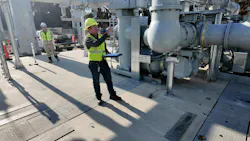
A network of abandoned coal mines lies beneath the city of Belleville, Illinois. To strengthen the regional transmission network, improve customer reliability and expedite restoration, Ameren Illinois faced a challenge: constructing a new substation in an area traditionally mined for its coal.
“This substation is designed to make the energy grid around Belleville more reliable and secure,” said Harman Ormani, Ameren’s project manager for the Goalby Substation. “We carefully studied the layout of the transmission system and determined that building the facility here would provide valuable benefits to a large number of customers.”
However, with coal mines undermining much of the area, Ameren’s engineering and construction teams faced unique challenges during the project. Historically, Belleville operated numerous independent coal mines, and several of them have unmapped sections, creating ambiguity about where and what needs to be stabilized.
To achieve its mission of designing and constructing a substation on a compact footprint, Ameren Illinois turned to GIS technology for its Goalby Substation in Belleville, Illinois. This approach allowed the crews to house the advanced equipment in smaller enclosures and reduce the areas that required grouting.
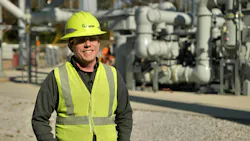
“The compact GIS design reduced the area that needed to be filled, reducing the cost, complexity, and risk associated with mine mitigation,” said Dan Crockett, substation engineer for Ameren Illinois. “Ameren was able to effectively mitigate the known underground issues, reduce the site preparation schedule, safely install the GIS and do so in a cost-conscious way that addressed the reliability concerns we were looking for to address our customers.”
Devising a Plan
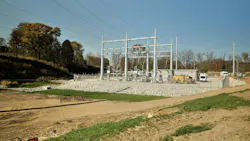
Engineers explored the possibility of tapping into an existing transmission line, which needed to be segmented into multiple lines. An existing four-way tap into the transmission line presented the ideal location, as other available parcels would incur significant transmission line relocation costs. Unfortunately, the entire area surrounding the four-way tap was nearly completely undermined.
A traditional substation would have required extensive mitigation to safely address underground conditions for the entire substation footprint. Mitigation for an abandoned coal mine involves drilling into the voids left by the removal of the coal seam and filling them with grout to prevent a future collapse.
To make the location suitable for the project, the field workforce had to grout the old mines. Because this was an expensive endeavor, the substation's footprint needed to be as small as possible.
The GIS design also allowed Ameren Illinois to keep costs low for its customers while maintaining the highest levels of safety, performance and reliability, Ormani said.
“The compact layout reduced the amount of engineering work required to mitigate possible issues caused by the mine,” he said. “It’s a relatively unique situation. These GIS designs are typically built in very crowded downtown city blocks and other places where space is limited.”
Designing the GIS Facility
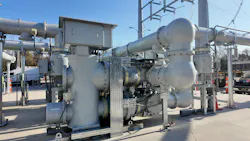
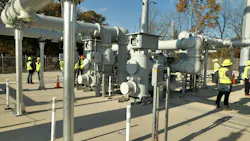
Unlike traditional air‑insulated substations, the Goalby Substation uses sealed bus work inside a pressure vessel filled with insulating gas. Because of the fully sealed buswork, the substation can be built with the same operational functionality as an air-insulated substation, but on a fraction of the land. Using a third of the space of an air-insulated substation comes with several project-specific benefits, Crockett said.
“That smaller footprint makes it possible to build the facility in a physically constrained area,” Crockett said. “We captured significant cost savings by reducing our mine subsidence mitigation area by about 75%, as well as selecting a location that is otherwise generally unusable. Altogether, it made for a cost-conscious approach to improve reliability and resiliency for our customers.”
Goalby also uses Ameren's standard protection and control designs, control enclosures and incoming line structures with minimal modifications.
"From a design perspective, our team worked hard to develop internal GIS standards that remained as close as possible to our existing air-insulated substation standards,” Crockett said. “This reduced the need for additional training for our field workers and minimized design costs, which were appropriate.”
Because Ameren Illinois bought GIS as a complete system, like an EHV transformer purchase, the utility relied on the GIS equipment manufacturer for equipment engineering with its oversight. That way, the design team could ensure the GIS equipment remained compatible with existing Ameren protection and control standards.
Investigating GIS
Ameren blazed a trail in the transmission and distribution industry with this project, which uses outside GIS technology. In North America, most substations of this kind are enclosed in dedicated structures, with most lines entering via underground cables in dense urban environments. In these air-insulated substations, most of the bus work is exposed, whereas in a GIS substation, it is completely enclosed, eliminating the need for wildlife protection.
Before opting for an exposed GIS design, Ameren researched the full lifecycle costs of the location, the maintenance costs of the structure versus the exposed equipment and the site-specific challenge.
“This approach naturally evolved from considering that all existing lines would remain overhead,” Crockett said. “This project, from start to finish, focused on what would meet our customers’ long-term needs and deliver the long-term reliability benefits.”
While North American utilities are used to gas-insulated dead tank breakers, GIS adds gas-insulated switches and buswork to the mix. Crockett said GIS is a new way of doing something Ameren Illinois has always done — delivering power reliably and cost-effectively.
“While GIS may feel foreign at first, the underlying technology behind a complete GIS substation is virtually identical to gas-insulated dead tank breakers for air-insulated substations,” Crockett said. “As the grid gets more complex, and individual communities’ needs change, GIS can be a tool to address those needs in an effective way.”
Overcoming Challenges
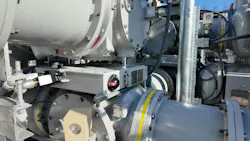
Operationally, the team faced two primary concerns during the Goalby Substation project: monitoring gas leaks and safeguarding its workers. For example, the substation contains 32 independent gas compartments, given the near-complete gas insulation. To assist the maintenance department, Ameren Illinois installed a gas density monitoring system in every zone to provide real-time data on the exact gas density in each zone.
“Should an insulating gas leak occur, this system allows our maintenance team to make informed maintenance decisions early,” Crockett said. “It provides an alarm at the first sign of a leak as opposed to receiving alarms only once enough gas has leaked to be a cause for concern. It’s another way we’re trying to improve our environmental stewardship, reliability and resilience for our customers. “
As for operations, Ameren Illinois focused on safety and relied on visual opens to protect its workers. Within the GIS equipment, however, open points are not immediately visible because they are contained within the pressurized disconnect switch housing.
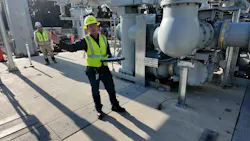
To perform open point verification, technicians must look directly through a viewing window or use a remote camera system and verify adequate levels of insulating gas in the switch compartment. To overcome this obstacle, Ameren Illinois communicated the locations and procedures through on-site training.
Exploring Other Applications
Ameren Illinois constructed and energized the Goalby Substation in November 2025 following six months of construction, excluding mine mitigation. The project’s civil construction followed a typical timeline, but once the workers poured the foundation, the substation assembly took about a third as long.
“Our manufacturer shipped many of the GIS components pre-assembled as large as typical freight shipping would allow for,” Crockett said.
After successfully building the GIS facility in Belleville, Ameren Illinois is looking to see where the technology may make sense in other parts of its service territory. The experience of building this GIS station is valuable as the utility continues to learn how it can further implement this substation design.
“Other locations with poor ground conditions, dense urban centers or other cost constraints are some of the factors that lead us to consider constructing a GIS rather than a conventional air-insulated substation,” Crockett said. “As the needs of our customers change, we’ll continue to evaluate GIS on a case-by-case basis, and if the local conditions, system needs, and cost considerations line up, another GIS in the Ameren territory becomes more likely.”
For Crockett, the project reinforced the importance of considering community needs and matching technology to local contexts rather than applying a one-size-fits-all approach. He said gas‑insulated substations can be a practical solution in areas with space constraints or where unique conditions, such as mines, property acquisition cost or environmental contamination, limit options and create project constraints.
“GIS can be an effective solution where traditional designs aren’t practical, without compromising reliability,” Crockett said. “The Goalby Substation shows how thoughtful design choices can deliver customer benefits while respecting both community and environmental constraints.”
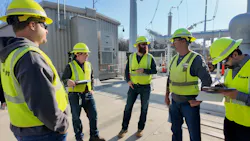
Lessons Learned: Sharing Four Tips for Other Utilities Considering GIS
In Belleville, Illinois, Ameren Illinois was able to save space, reduce costs and overcome complex engineering and installation challenges by going the GIS substation route. Here are a few tips for other utilities considering this type of construction in their service territory.
- Consider future expansion and repair. With no widely adopted standards dictating high-voltage connections between GIS components, it’s critical to develop a spare-parts strategy to minimize over-reliance on the manufacturer.
- Develop an RFP that specifically outlines the preferred protection and control design. Ameren identified several improvements to its internal RFP document and advised other utilities to invest significant time in this process.
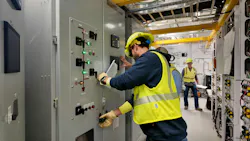
- Take the time to properly scope the project and account for GIS in the project schedule. GIS, as a new technology slotted into existing legacy grids, requires more planning to ensure its implementation is congruent with the current operating system.
- Develop an in-house standard for GIS local control cabinets in your RFP. Utilities are standardizing transformer control cabinets across vendors, and the same can be done with this type of equipment within a GIS substation.
Hometown Engineer Powers Belleville Community
By Evan Asher, Ameren Illinois
For most drivers cruising past the new Goalby Substation in Belleville, Illinois, it may look like just another piece of energy infrastructure. But for lifelong Belleville resident Dan Crockett, a longtime Ameren substation engineer, the project was a once-in-a-lifetime chance to help power the city he has always called home.
Ameren recently placed the new transmission substation in service, strengthening the local electric system and improving reliability for customers throughout the area. By creating another intersection for rerouting power during outages or severe weather, the substation is expected to reduce the duration and frequency of service interruptions for thousands of Belleville households and businesses.
Over the course of his seven-year career with Ameren, Crockett has contributed to transmission projects across the company's sprawling service territory in Illinois and Missouri. But working on this project in his own hometown was a satisfying first.
“Seeing my work built right here in Belleville has been incredibly meaningful,” he said. “I never expected to have this opportunity to design something for my own community."
The new facility is notable for its technology. The Goalby Substation is the first gas-insulated substation (GIS) on Ameren's transmission system. That means it's a compact, enclosed system that delivers the capabilities of a traditional air-insulated transmission substation, but on a much smaller footprint.
That smaller footprint — about one-third the size of a typical air-insulated substation — proved essential in Belleville, where historic coal mining activity left a network of old mine shafts beneath parts of the city. Ameren selected the compact GIS design to minimize the civil engineering and mine mitigation work required to fill the underground spaces beneath the new substation site.
“This GIS approach allowed us to keep costs as low as possible for customers while still maintaining the highest levels of safety, performance and reliability,” Crockett said.
In different ways, the Goalby Substation is a significant milestone for both Ameren and Crockett. The site is a technical achievement for the company and a personal achievement for this hometown engineer, helping to power the place he loves.
“I’m pleased to see Ameren investing in the Belleville community with this new substation,” Crockett said. “It takes a big team from Ameren and our contract partners to build new substations, and I feel so fortunate to have the opportunity to contribute in my own small way. This type of project helps to prime our city for long-term success and growth.”
About the Author
Amy Fischbach
Electric Utilities Operations
Amy Fischbach is the Head of Content for T&D World magazine and manages the Electric Utility Operations section. She is the host of the Line Life Podcast, which celebrates the grit, courage and inspirational teamwork of the line trade. She also works on the annual Lineworker Supplement and the Vegetation Management Supplement as well as the Lineman Life and Lineman's Rodeo News enewsletters. Amy also covers events such as the Trees & Utilities conference and the International Lineman's Rodeo. She is the past president of the ASBPE Educational Foundation and ASBPE and earned her bachelor's and master's degrees in journalism from Kansas State University. She can be reached at [email protected].