How AI Data Centers Are Changing Power Demand on the Grid
Key Highlights
- PJM capacity prices rose 833 percent in a single delivery year.
- One Virginia fault dropped 1,500 megawatts of AI load in under a second.
- AI power swings can ramp 1,000 megawatts per second at gigawatt scale.
- New transmission takes 7 to 10 years, while a data center takes 2.
- Real time sensing can unlock 20 to 30 percent more grid capacity today.
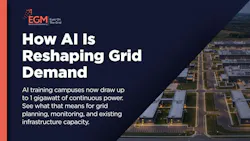

A practical look at what the growth of AI infrastructure means for utilities, grid operators, and the investors who support them.
The growth of AI and hyperscale data centers is creating a sustained rise in electricity demand that US utilities are working to plan for. Even at half of current industry forecasts, load growth over the next twenty years is projected to run roughly three times faster than it did over the prior twenty, arriving on a timeline much shorter than traditional infrastructure investment cycles.
How AI Load Differs
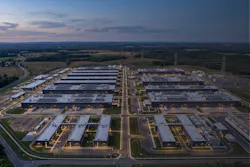
A traditional enterprise data center draws 5 to 20 megawatts. An earlier hyperscale facility might reach 150. A large AI training campus in 2026 draws 500 megawatts to 1 gigawatt, and the next generation is designed at 2 to 5 gigawatts, changing the category of grid infrastructure required.
The power draw behaves differently too. Training workloads oscillate because tens of thousands of GPUs execute identical steps in lockstep, alternating between a high draw compute phase and a lower draw synchronization phase every 3 to 10 seconds. Research published in August 2025 by NVIDIA, Microsoft, and OpenAI documented ramp rates exceeding 1,000 megawatts per second at gigawatt scale. Inference, now 80 to 90 percent of AI compute consumption, follows the random arrival of user queries and spikes around viral events, so the grid needs reserve margins to absorb variability unlike traditional industrial load.
Where the Constraints Sit Today
Constraints appear at every layer. PJM's 2027 to 2028 capacity auction cleared 6,600 megawatts below its reliability target, and PJM congestion costs escalated from 1.8 billion dollars in 2024 to 3.2 billion in 2025. Large power transformer lead times stretched from roughly 140 weeks in 2023 to over 160 by 2026, with a 30 percent shortfall projected through 2030.
Geography compounds this. In Virginia, data centers already account for over 20 percent of state electricity generation, headed toward 50 percent by 2030. Across PJM, they drive 94 percent of projected load growth through 2030, and capacity prices rose 833 percent in a single delivery year.
Timelines sit underneath it all. A campus is built in 18 to 24 months. Its substation needs 3 to 5 years. The transmission line takes 7 to 10 years.
Grid Impact by Scale
|
Scale |
Grid Impact |
|
1 to 10 MW |
Sustained load on feeders and transformers. Neighboring customers may see degraded power quality. |
|
20 to 25 MW |
Formal interconnection study required. Queue begins. |
|
50 to 100 MW |
Substation changes required. Upgrade costs spread across the territory. |
|
75 to 300 MW |
NERC reliability framework applies. Simultaneous disconnection becomes a documented hazard. |
|
>20% of regional zone |
Capacity markets reprice. The region absorbs the cost. |
The Simultaneous Disconnection Challenge
AI data center equipment runs on tighter voltage tolerance windows than most large industrial consumers. UPS systems transfer to backup power on a deviation of just 5 to 10 percent sustained beyond 40 to 66 milliseconds. Because many facilities in a region share similar protective settings, one disturbance can disconnect many at once. On July 10, 2024, a failed lightning arrestor on a 230 kilovolt line in Virginia triggered a voltage dip lasting under 70 milliseconds, causing 1,500 megawatts of load from 60 facilities across 25 substations to disconnect in under one second. Reconnection compounds it, as UPS battery banks recharge simultaneously and add a demand surge while the grid is still recovering. NERC noted the pattern fell outside what operators had anticipated, and in May 2026 issued a Level 3 Alert requiring dynamic fault recording devices for computational loads, with responses due August 3, 2026.
Getting More From Infrastructure Already Built
New generation, transmission, and substation investment is necessary and is happening. Alongside it, a complementary approach is gaining regulatory momentum: extracting more usable capacity from assets already built. FERC calls this category Grid Enhancing Technologies, or GETs, and in June 2026 issued show cause orders under Docket No. RM26-4 requiring all six US regional grid operators to formally evaluate GETs in their large load integration plans.
Dynamic Line Rating is one of the most practical options today. Most transmission lines are rated on static assumptions set without knowledge of actual conditions. DLR replaces those with live sensor data, letting utilities calculate real thermal capacity as temperature, wind, and loading change. A May 2026 PJM congestion event showed real time monitoring could have added 12.3 percent capacity on the constrained line, worth roughly 100 million dollars over 72 hours.
Closing the Monitoring Gap
SCADA collects telemetry at the substation level on minute scale timescales, fine for the loads it was built for but not for AI campuses. Fault location still depends on physical line patrol, with US average CAIDI reaching a record 7.4 hours in 2024, most of it spent searching rather than repairing. Operators also have limited real time visibility into large load behavior, and conventional monitoring rarely catches precursor conditions like rising conductor temperature or nearby vegetation.
EGM's Meta-Alert platform delivers that visibility. Its patented Accurate Fault Location and Detection system, independently validated by the US Department of Energy's National Laboratory of the Rockies across 26 blind tests, locates faults within a single pole span of about 300 feet, compressing response from 3 to 5 hours of line patrol to roughly one hour. Each sensor cluster monitors over 60 electrical, physical, and environmental parameters, and its Dynamic Line Rating module calculates available capacity continuously from that data, with deployments showing up to 50 percent improvement over static ratings. For simultaneous disconnection, sensors at the utility service entrance, where UPS systems make their disconnect decision, capture voltage events before the trip occurs.
The system installs on energized lines without service interruption, needs no field calibration, and is operational within hours. A typical 500 megawatt campus deployment uses 8 to 14 sensor clusters in 60 to 90 days, satisfying the NERC Level 3 Alert's recording requirements, with validated return on investment under one year.
Read more about where AI-driven demand is creating pressure across generation, transmission, and substations—and how utilities are responding.
Understanding the load characteristics, the scale thresholds, and the monitoring gaps is the starting point for responses that work for utilities and their customers. To learn more about EGM's Meta-Alert platform or request a Grid Vulnerability Assessment, visit egm.net