Increase Pole Life by 20 Years: Choosing the Right Barrier System
Key Highlights
- Groundline protection significantly reduces moisture ingress and biological decay.
- Ten-year BRE studies showed protected groundlines remained dry and decay-free.
- Eight-year Uganda trials found protected poles free from biological attack.
- Total barriers outperform partial wraps by preventing moisture migration behind protection.
- Protecting the groundline builds grid resilience and reduces replacement costs
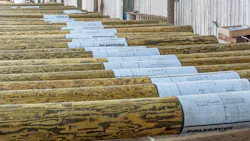

Wood poles remain the backbone of electricity distribution networks across much of the world. Utilities continue to rely on wood because it offers an attractive combination of strength, cost and ease of installation.
But the humble wood pole is under constant threat from a myriad of environmental factors, and one of the worst starts at its foundations.
The groundline is where moisture, fungi and insects combine to create ideal conditions for decay. As wood ages, utilities face a familiar cycle of inspections, remedial treatments and ultimately replacement. The question, therefore, is whether adding groundline protection before a pole is installed can fundamentally change that cycle.
Independent research show it does. A series of field and laboratory studies investigated the effect of adding a total barrier around the groundline section of treated wood poles. Rather than simply wrapping the timber, the composite Rot-Guard system bonds to and seals the pole surface, preventing the conditions that cause decay while reducing the loss of wood preservative and ground contamination in this vulnerable zone.
The principle is simple: by preventing moisture from reaching the wood, the system makes it considerably harder for biological decay to take hold. Total barriers lower the entry point for moisture from the ground, helping keep moisture levels at the top of the barrier below the critical threshold for decay to occur.
Why the Groundline Matters
Most wood poles fail from the outside in. Although preservative treatments protect the wood, repeated wetting and drying leads to loss of preservative over time. Combined with oxygen and organic matter in the soil, high moisture levels create prime conditions for decay at the ground line, which reduces pole strength and leads to pole failure.
Simply placing a protective material around the groundline isn’t necessarily enough. If a wrap, tape or other barrier does not fully penetrate and seal the pole surface behind the barrier, moisture can track upwards behind it, reaching the top of the protected zone.
Rot-Guard takes a different approach. Its dual-layer total barrier system is designed to bond and seal the wood behind the durable thermoplastic outer shield. Instead of merely covering the groundline, it fully seals the protected section to restrict moisture entry. As well as isolating the pole from wood destroying fungi, the barrier system also keeps the critical groundline zone as dry as possible throughout the pole's service life.
Evidence from the Field
Laboratory testing is useful, but utilities ultimately want to know how products perform under real operating conditions.
One of the most demanding evaluations of Rot-Guard total barriers was in Uganda, where high temperatures, heavy rainfall and termite activity create an exceptionally aggressive environment for wood poles. Researchers monitored more than 200 distribution poles over an eight-year period, comparing treated poles protected with Rot-Guards with treated only controls.
The contrast was striking. While treated poles showed evidence of both fungal decay and termite attack within the test period, treated poles with the Rot-Guard total barrier remained free from biological and termite attack.
The results demonstrate how effectively excluding moisture can interrupt the decay cycle.
Moisture Is the Critical Variable
The Uganda trial is supported by a series of independent studies undertaken by the UK's Building Research Establishment (BRE), which investigated what happens inside the protected groundline zone.
After ten years in service, treated poles protected with the Rot-Guard total barrier remained dry around the groundline and free of decay, while treated only poles exhibited surface wetting, algae growth and the early stages of decay (test site pictures below).
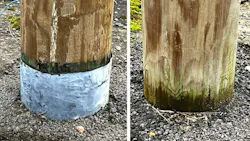
Accelerated laboratory testing produced similar results. Treated wood protected by the Rot-Guard total barrier consistently maintained moisture levels below those required for fungal growth. In contrast, samples without Rot-Guard protection held higher moisture levels, creating conditions more conducive to fungal growth and decay.
The findings reinforce an important principle of wood durability: preservatives play a vital role, but preventing water from entering the wood changes the conditions that allow decay to begin in the first place.
Not Every Barrier Performs Equally
One particularly interesting study compared several common groundline protection methods, including simple wraps, adhesive tapes and bag-style systems.
Although each provided some degree of physical protection, researchers observed moisture migrating behind the partial barrier systems, particularly near their upper edge. Over time, this created the conditions for decay to develop above the protected section, leading to pole failure.
By comparison, the Rot-Guard total barrier prevented detectable moisture ingress throughout the protected zone.
For utilities evaluating groundline protection technologies, the distinction between partial and total barriers is significant. The research shows that eliminating moisture ingress, rather than simply reducing it, has important implications for long-term asset performance.
From Durability to Grid Resilience
Ultimately, extending service life only matters if structural performance is preserved.
Independent accelerated decay soil-bed testing found that treated wood samples with the addition of Rot-Guard total barriers retained their original MOR strength, while the preservative treated but unprotected samples experienced strength losses averaging 20%.
For utilities, that finding reaches beyond maintenance planning. Retaining pole strength for longer supports grid hardening programmes and removes the requirement to specify larger wood poles (which are becoming increasingly difficult to source), or more expensive steel or composite alternatives to meet longevity targets.
Looking at the Bigger Picture
Taken together, the body of independent evidence tells a remarkably consistent story. Excluding moisture from the groundline by sealing the pole with a total barrier reduces biological attack, preserves structural integrity and extends the service life of wooden poles significantly. The available evidence shows that a substantial life extension of 20 years is both realistic and achievable.
For utilities facing ageing infrastructure, tighter budgets and increasing reliability expectations, that raises an important question. If the greatest threat to wood poles exists within a few inches of the ground, could protecting this vulnerable zone be one of the simplest and most cost effective ways to improve network resilience?
About Polesaver
Polesaver has commissioned six independent studies, including long-term field trials and laboratory investigations on its products over a 25 year period. Its Rot-Guard total barrier is also proven in volume use over 30 years by utilities globally.
Get in Touch
Readers are invited to request the Review & Analysis of Polesaver test data, compiled by Dr Craig R. McIntyre of McIntyre Associates. With over three decades of experience, Dr. Craig R. McIntyre provides expert consulting services on wood preservation, fire retardants for wood, and standardization procedures. He was recently honoured with the AWPA Award of Merit, their most prestigious honour.