Managing Grid Risk in a High-Stress Operating Environment
Key Highlights
- Grid risk is increasingly concentrated in small, high-consequence points where load, condition and environment intersect
- Aging assets are being pushed into higher-risk states under increasing load and more volatile climate conditions
- Early fault detection (EFD™) enables real-time identification and location of faults before failure or ignition
- It supports wildfire mitigation by preventing ignition events, not just improving visibility
- The technology improves reliability and operations by enabling predictive maintenance, reducing outages, and minimizing field response time
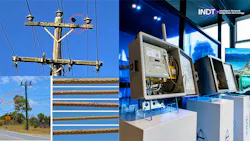

Ongoing wildfire risk across North America continues to highlight the complex and multi-factorial nature of fire ignition. Weather, vegetation, human activity and infrastructure all play a role, and, in many cases, no single intervention could have prevented an event.
For utilities, however, the more practical question is different. Which risks within the network can actually be detected and mitigated early enough to prevent escalation?
This is where early fault detection (EFD™) is emerging as a critical operational capability. IND Technology’s EFD™ system is at the forefront of this shift, providing utilities with the ability to detect and locate developing faults before they escalate into outages or ignition events.
A system under stress, with risk concentrated in critical points
Across North America, aging electricity networks are being asked to carry more, under increasingly volatile conditions.
Electrification is driving higher baseline demand, while data centers introduce highly concentrated, continuous loads. At the same time, distributed energy resources are reshaping power flows in less predictable ways. Combined with more frequent extreme heat, prolonged drought and high wind events, the result is a grid that is not only more complex, but more heavily loaded and less tolerance for disruption.
In this environment, risk does not scale evenly.
A relatively small number of components carry a disproportionate share of ignition and reliability risk. These are not necessarily the largest assets, but locations where condition, load and environment intersect, such as spans with marginal clearance, connectors under mechanical stress, or insulators showing early-stage degradation.
Under elevated system stress, these defects can transition rapidly from manageable issues to ignition sources. The challenge is that many of these risks remain effectively invisible until they are close to failure.
The visibility gap in traditional approaches
Most utility asset management frameworks are built around periodic inspection, lifecycle modelling and event-based protection. These approaches remain essential, but they are not designed for conditions where asset state can change rapidly between inspection cycles.
A line that passes inspection today may operate under materially different stress tomorrow. A component that is technically within tolerance may behave very differently under peak load or extreme weather conditions.
Protection systems, while critical, operate after a fault occurs. They are not designed to detect developing issues.
This creates a growing gap between what is known about the system and what is actually happening in real time, particularly in high wildfire risk environments.
Closing the gap with EFD™
Early fault detection (EFD™) closes this gap by enabling continuous monitoring of electrical activity along transmission and distribution lines, identifying the signatures of developing faults before they escalate.
IND Technology’s EFD™ system uses RF-based sensing, with sensors typically spaced up to several miles apart, to detect and precisely locate early-stage faults. The system identifies phenomena such as partial discharge, intermittent arcing, conductor movement and vegetation contact before conventional protection systems operate.
This provides utilities with a practical window to intervene ahead of failure.
EFD™ systems are now deployed across more than 20 investor-owned utilities and cooperatives in the United States, Canada and Australia. In these environments, utilities are identifying developing defects days or months before failure and taking action before they escalate into outages or ignition events. The technology is increasingly cited in utility Wildfire Mitigation Plans as a critical threat barrier. EFD™ is consistently ranked among the highest performing approaches for risk reduction per dollar invested in mitigating wildfire risk from electrical infrastructure.
From detection to prevention
Many wildfire ignitions linked to electrical infrastructure originate from early-stage faults such as intermittent arcing, conductor contact or insulation breakdown. These events may occur sporadically before escalating into sustained faults capable of igniting surrounding vegetation.
By identifying these signals early using EFD™, utilities gain options that are not available once a fault has fully developed. These include targeted inspections, pre-emptive maintenance, temporary load adjustments or de-energization under high-risk conditions.
In practice, utilities are using EFD™ to prioritize field response on elevated fire risk days, focusing crews on specific spans or components rather than broad patrols.
This positions EFD™ as a preventative operational control rather than simply a monitoring tool.
Operational integration and reliability benefits
The value of EFD™ is realized not just in detection capability, but in how it is integrated into day-to-day operations.
By identifying defects before failure, utilities can move from reactive response toward condition-based maintenance. Operational impacts include:
- Reducing unplanned outages
- Faster fault location and investigation
- More targeted crew dispatch and grouping of work
- Reduced need for routine patrols
These improvements translate into measurable reliability benefits, including reductions in SAIDI and SAIFI in targeted deployment areas.
Utilities are deploying EFD™ in a focused manner, prioritizing high wildfire risk circuits, heavily loaded assets, and areas with known vegetation interaction.
Integration into control room workflows is critical. EFD™ insights are used to inform operational decision making, trigger proactive dispatch and support maintenance planning.
Targeted risk reduction and investment efficiency
A key advantage of EFD™ is its ability to support targeted risk reduction.
Rather than relying solely on broad system wide capital interventions, utilities can focus resources on the relatively small number of network segments where risk is most concentrated.
Within risk spend efficiency frameworks used by some United States utilities, EFD™ has demonstrated strong relative performance compared to traditional mitigation approaches, particularly where deployment is focused on high-risk circuits.
Looking ahead
The transformation of the North American electricity system is well underway.
Electrification, digitalization and climate variability are reshaping both demand and operations. Wildfire risk is one manifestation of this broader shift.
For utilities, the implication is clear. Managing this environment will increasingly depend on improving how the system is observed, understood and acted upon in real time.
Early fault detection (EFD™) is becoming a defining capability in this transition, enabling utilities to move from reactive response to preventative action, and from broad investment strategies to more targeted, data-driven risk reduction.
In a high-load, climate-exposed grid, the ability to detect and act on emerging faults early will play an increasingly important role in both reliability and wildfire risk mitigation.
For more information, please visit https://ind-technology.com/.
About the Author
Professor Alan Wong is Founder and CEO of IND Technology and a specialist in high-voltage insulation and sensor systems. He leads the high-voltage research group at RMIT University and has worked with utilities across Australia, Asia and North America.
About IND Technology
IND Technology develops and manufactures the EFD™ system for transmission and distribution networks. The technology is deployed across North America and Australia to improve reliability and reduce wildfire risk.