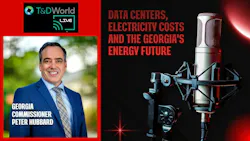
T&D World Live Podcast: Georgia Commissioner Peter Hubbard on Data Centers, Electricity Costs and The State's Energy Future
Listen Now!
In this episode of the T&D World Live Podcast, we speak with Peter Hubbard, commissioner of the Georgia Public Service Commission, about the challenges of keeping electricity affordable and reliable as Georgia experiences significant growth in electricity demand. Their conversation explores the effects of data center development on utility planning and customer bills, the role of regulators in scrutinizing utility investments, and opportunities to expand renewable energy and energy storage.
Hubbard describes Georgia as being in a period of major electric infrastructure expansion, including new generation, more than 1,000 miles of new transmission lines and more than 1,100 miles of transmission rebuilds. Much of this development is tied to data center demand. At the same time, recent rate increases have heightened concerns about affordability, prompting questions about how the costs of new infrastructure should be allocated among large electricity users and residential customers.
Data center growth and ratepayer protection
A central topic is how Georgia should accommodate data centers while protecting other electricity customers from bearing disproportionate costs. Hubbard discusses the need to account for both the incremental infrastructure required to serve new large loads and the costs of the existing electric system they will use. He says regulators must examine whether data centers are paying their appropriate share and consider how their flexibility and backup battery systems could provide benefits to the grid.
Hubbard also discusses a 3,200-MW electricity supply contract between Georgia Power and OpenAI. He raises concerns about the scale of the proposed investment, the potential risks if data center demand does not materialize as expected, and the possibility that costs could ultimately be shifted to other customers. He notes that the contract was subject to a 30-day review period and argues that large-load agreements need adequate protections, including meaningful early termination provisions and plans for mitigating financial risks.
Electricity affordability and utility oversight
Hubbard argues that regulators should take a more proactive approach to utility oversight rather than simply accepting the resource and transmission plans presented by investor-owned utilities. He advocates for closer examination of utility costs, more comprehensive rate cases and alternatives that could improve affordability without compromising reliability.
He also discusses Georgia's decision to freeze rates following several increases, explaining that the absence of a more recent rate case leaves regulators relying on a cost-of-service study conducted before the data center boom. Without updated information about how different customer classes use the grid and contribute to its costs, he says, regulators cannot fully determine whether large electricity users are paying an appropriate share.
For Hubbard, consumer advocacy means asking whether utility decisions will reduce system costs over time and whether the financial benefits associated with new large customers can be directed toward residential ratepayers.
Making better use of existing transmission infrastructure
The discussion examines ways to meet growing electricity demand without relying exclusively on new infrastructure. Hubbard highlights advanced transmission technologies, including reconductoring existing lines with higher-capacity conductors while retaining existing towers and rights of way.
He describes a joint effort involving the Georgia Public Service Commission and Georgia Power to seek U.S. Department of Energy funding for reconductoring a 230-kV circuit. Although the application was unsuccessful, he sees the approach as an example of how utilities could use existing infrastructure more effectively and potentially defer additional transmission construction.
Hubbard also discusses the potential for batteries to help move energy through the grid more efficiently and increase the value of existing transmission assets.
Expanding solar energy and energy storage
Hubbard sees opportunities for Georgia to expand solar power, particularly through community solar, warehouse rooftops, municipal buildings, parking lots and residential installations. He notes that Georgia ranks relatively well in utility-scale solar capacity but much lower in residential rooftop solar per capita.
He also points to the state's solar manufacturing industry and workforce as potential advantages. In his view, regulators should ensure that the economic benefits of lower-cost clean energy are accessible to residential customers rather than being limited to utility procurement decisions or other market participants.
Solar paired with battery storage receives particular attention. Hubbard explains that the combination can shift electricity supply to periods of higher demand, flatten peak loads and make better use of the grid. He acknowledges that solar is intermittent and batteries have limited energy duration, meaning the system must still account for extended periods when stored energy cannot be replenished.
He argues that resource planning should evaluate solar and batteries based on their actual contributions to reliability. He questions the assumptions used to accredit different resources in Georgia's procurement process, noting that gas-fired generation receives full capacity accreditation while batteries receive a much lower rating. He believes this disparity can disadvantage storage in competitive procurement.
Natural gas, nuclear power and the costs of generation
The episode also examines the role of conventional generation as electricity demand grows. Hubbard recognizes that natural gas-fired combined-cycle and combustion-turbine plants provide valuable dispatchable capacity, but he questions whether Georgia is becoming too dependent on gas. He emphasizes that evaluating generation costs requires accounting for fuel purchases, pipeline infrastructure and other costs over a plant's operating life.
He also argues that the potential costs associated with carbon emissions and climate-related impacts should be considered in utility planning. As an example, he references Georgia Power's request for $912 million in storm cost recovery earlier in 2026, primarily related to Hurricane Helene.
On nuclear power, Hubbard acknowledges the operational benefits of Georgia's Vogtle Units 3 and 4, which provide carbon-free generation and can displace coal and gas in the dispatch order. However, he highlights the substantial cost overruns and delays associated with the project. He says future nuclear development would require firm protections against cost overruns and should be considered alongside less expensive opportunities, including renewables and storage.
Can clean energy lower electricity costs?
Hubbard challenges the idea that cleaner electricity necessarily comes at a higher cost to consumers. He points to Texas' expansion of solar generation and Australia's periods of abundant solar production as examples of how renewable resources can affect electricity costs.
He emphasizes that solar installations can operate for decades without fuel costs, while gas-fired plants may have relatively low initial construction costs but substantial ongoing fuel expenses. He argues that utilities and regulators should reconsider traditional assumptions about peak-generation resources and evaluate whether solar paired with batteries can meet some needs currently assigned to gas-fired plants.
Throughout the conversation, Hubbard returns to the need for utility planning that considers the full costs of resources, maintains reliability and protects customers from unnecessary expenses.
The episode concludes with a broader discussion of how Georgia can manage rapid electricity demand growth while improving affordability. Hubbard's perspective centers on more rigorous utility oversight, fair allocation of infrastructure costs, more effective use of existing transmission assets and a broader evaluation of generation options, including solar, storage, natural gas and nuclear power.
This episode synopsis was created with the help of AI.