NEETRAC Examines Implications of IEEE Entity Standards for North American Utilities

Today, corporations and governments can develop IEEE standards without input from individuals. How? IEEE has two standards development processes—one for Individuals and another for Entities that include corporations, governments, and universities among others. The IEEE Standards Association (IEEE SA) bylaws are clear:
“Participants in the IEEE standards development individual process shall act based on their qualifications and experience. Entity representative participants in the IEEE standards development entity process are appointed by an entity to represent that entity and act on its behalf. Such representatives may participate in IEEE standards development activities and take action based upon instruction from the entity for which they have been appointed as an entity representative.”
Since 2018 in the Power and Energy industry, one entity in particular has used the process more than any other—the Chinese government. Through its state-owned corporations and universities, the Chinese government has used IEEE SA’s entity standards process to publish internal standards as international standards. This is driven by the Chinese government’s ‘Belt and Road Initiative’, which includes plans to convert 85% of Chinese National Standards into international standards by 2035. The work for this initiative has been realized across many international Standards Development Organizations (SDOs) including IEEE, where the entity standards development process has been the primary vehicle. As stated on IEEE SA’s website, the entity standards development process allows governments and corporations to “engage and influence technology development to ensure their organizations’ interests are represented.”
As of June 17, 2025, IEEE’s Standards Association website showed that there are 53 released entity standards and 52 under development, with the majority originating from Chinese entities. We do not have a technical opinion on the applicability of most of the electric power transmission and distribution entity standards, both those published and those being developed. They may include new and useful information North American engineers should consider when developing their own companies’ design, O&M, and purchasing standards. However, they may also include information that conflicts with various North American regulatory requirements, such as GO 95 and the NESC as well as other industry standards such as ANSI and ASTM commonly used in North America.
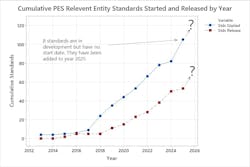
While we believe that North American engineers have not used these standards, their potential use in North America poses unknown but potentially significant risk to the safety and reliability of the North American power grid because these standards were not developed with the intention of being applicable to North American electrical T&D systems. IEEE 1863-2024 was developed with the primary intention of being applicable to State Grid of China’s power grid, which can be seen with statements such as “…provides China’s experience…, corresponding anti-vibration measures used in China,” etc. Additionally, it directly discusses details of practices performed or conditions experienced within China seven different times.
Examples of entity standards conflicting with North American requirements include IEEE 1863 (Guide for Overhead AC Transmission Line Design). Originally released in 2019 and still available for purchase, the 2019 version clearly did not comply with portions of the NESC. IEEE 1863-2019 specifies a 50-year windspeed mean recurrence interval, while the NESC requires 100 years. It describes a linear conductor model for computing line tension rather than the non-linear model used by PLS-CADD and Sag10. IEEE Power and Energy Society’s (PES) Overhead Lines subcommittee of the T&D committee provided IEEE with 194 objections to its publication.
Another example of a standard that conflicts with North American requirements includes connector standard IEEE 2870 (Grip Test Method Guide for Fittings of High-Temperature, Low-Sag Overhead Conductor under Tension and Electric Current Co-effect), which was published in 2022 and conflicts with ANSI C119 and IEC 61284. For IEEE 2870, individuals on the T&D Overhead Lines Subcommittee and NEETRAC members originally submitted 79 comments. The fact that only one other balloter (a Chinese based entity) submitted a single comment concerns us.
Each membership type has its own standards development process requirements. The differences between individual and entity standards go well beyond membership requirements and voting procedures presented in Table 1. The individual process develops standards exclusively with independent engineers providing technical expertise to develop standards with the best interest of the public good in mind. IEEE is explicit that these individuals do not represent corporations. On the other hand, the entity process is open only to corporations and governments for the purpose of promoting those entities’ corporate interests.
|
Table 1: Individual vs Entity Standards |
||
|
Difference-Factor |
Individual |
Entity |
|
Membership difference |
Individual persons |
For-profit and non-profit corporations, governments, universities, etc. |
|
Membership requirements to take part in working groups inside of PES |
· IEEE individual membership · IEEE PES individual membership |
· IEEE Standards Association Entity Membership |
|
Membership requirements to vote on standards |
· IEEE Standards Association Individual Membership |
|
|
Number of members needed to form a working group |
10 |
3 |
|
Number needed to vote on a standard |
10 |
5 |
|
Purpose |
Protect the public welfare |
“[E]ngage and influence technology development to ensure their organizations’ interests are represented.” |
To the untrained eye, the published format of standards developed using both methods is virtually indistinguishable. IEEE Technical Committees do not oversee the technical accuracy of standards their working groups develop. Only the working group members (individual or entity) as well as the balloters (individual or entity) provide technical oversight. The Technical Committee only ensures that working groups follow IEEE’s standards development process. In meetings with NEETRAC’s engineering staff, representatives from the IEEE Standards Association expressed a ‘buyer beware’ sentiment—all standards are equal, and it is up to the user to decide if a standard meets their needs. IEEE’s website confirms this sentiment.
We recognize that other SDOs as well as other IEEE Professional Societies routinely publish conflicting standards. The entity standards development process has been used effectively in other IEEE Professional Societies. However, this alternative method is relatively new to the Power and Energy Society’s (PES) technical committee members and deviates from the traditional method with respect to purpose and transparency to which the North American PES members are accustomed. While we agree with the view that users should decide if a standard meets their needs, prior to Chinese entities utilizing IEEE’s entity standards development process, most standards developed by PES technical committees were highly North American-centric. Consequently, we believe North American utility engineers have often not felt the need to provide a thorough and critical review of IEEE standards they use to design, specify or operate their systems. With the advent of entity standards being developed by and for at least one other region’s power grid, North American based engineers should no longer accept IEEE standards as applicable to their systems without a thorough review.
Once published, all IEEE standards are considered equivalent, regardless of how they were developed. Additionally, under the auspices of Technical Committees, who control process but not content, individuals and entities can change each other’s standards after publication. The result is uncertainty when selecting standards for applications. It is our membership’s consensus that regardless of the SDO that developed the standard, electric utility engineers, systems design engineers, and OEM product design engineers conduct a thorough critical evaluation of any standard’s applicability prior to using that standard in their product or system.
For more information about IEEE’s entity standards development process, please see https://standards.ieee.org/about/membership/organizations/.
We are the National Electric Energy Testing Research and Applications Center (NEETRAC), a 33-member consortium of North American electric utilities and their equipment manufacturers in Georgia Tech’s School of Electrical and Computer Engineering. While this opinion is the consensus of our membership, it should not be construed as the opinion of any individual NEETRAC member or employee or the opinion of the Georgia Institute of Technology. For more information about us please see https://neetrac.gatech.edu/