Year-Round Resilience: A 360° Approach to Storm Preparedness and Response
Key Highlights
- 2025 saw no landfalling hurricanes in the Southeast U.S., but extreme weather still caused significant disruptions and damages, highlighting the need for resilient infrastructure.
- Traditional manual damage assessments are slow, costly, and prone to errors; AI-enabled inspections can dramatically increase speed and accuracy, reducing outage times.
- A 360° storm response lifecycle—pre-storm hardening, immediate post-storm inspections, and ongoing validation—supports proactive resilience and continuous grid improvement.
- Advanced sensing tools like drones, satellites, and vehicle-mounted cameras enable scalable, real-time damage detection, even in hard-to-reach areas, improving situational awareness.
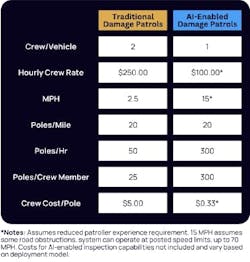
- Modern metrics focus on inspection speed, cost efficiency, and outage duration, with AI-driven workflows reducing inspection costs from $5.00 to $0.33 per pole and doubling inspection capacity.
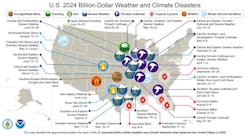
2025 marked the first time in a decade that no hurricanes made landfall in the Southeast U.S. Although that may seem like good news, it underscores a more unsettling reality: Extreme weather is becoming increasingly erratic and unpredictable. Despite the lack of direct impacts, 2025 still brought 12 named storms, including the devastating Category 5 Hurricane Melissa, which registered slightly below the average of 16.4 named storms over the past 25 years, but well within expected ranges.
We’ve entered an era where “storm season” no longer captures the year-round reality utilities face. Aging infrastructure is now exposed to a continuous cycle of overlapping threats, including hurricanes, typhoons, bomb cyclones, tornadoes, microbursts, polar vortices, blizzards, wildfires, flash floods, mudslides, and more.
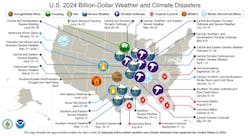
Storm-related outages are growing in frequency, severity, and cost. In 2024, NOAA reported 27 unique weather events with damages in excess of $1 billion. Swiss RE recently reported that the 4-year annual average for severe weather outages in the U.S. rose 57% from 2020-2023 when compared to 2016-2019, and outage-related grid damages exceeded $100 billion in some recent years.
Despite the increasing persistence and severity of extreme weather threats, many utilities still rely on manual storm patrolling workflows built for the 20th century. As weather pressures intensify, utilities must shift from reactive, resource-heavy responses to a modern, continuous storm management lifecycle.
A bold new approach to grid resilience is emerging—one rooted in smarter inspections, faster mobilization, and continuous improvement, with AI serving as the foundational tool enabling that transformation.
The Storm Response Bottleneck
Storms don’t just knock out power; they expose the limitations of legacy restoration workflows. Damage assessment, the very first step after a storm, remains largely manual. Crews walk or drive slowly along circuits to visually identify damage. This process is inherently slow, expensive, prone to human error, and difficult to scale, even with mutual aid.
Utilities do not just face resource challenges; they are also suffering from a modernization gap. Relying solely on more people is no longer viable. Instead, utilities must equip field personnel with tools that multiply their impact, unlocking greater speed and precision from the same or even fewer resources.
As better, technology-enabled options become available, maintaining the status quo for damage assessments results in a ripple effect of unnecessary outcomes. The chain impact includes delayed repair crew dispatches, suboptimal resource allocation and repair prioritization, extended outage durations, frustrated impacted customers, increased regulator scrutiny and rate pressure, and eroded financial performance to the utility and shareholders.
The Financial Impact of Delay
When the power goes out, every minute matters for the safety, well-being, and economic stability of affected communities. While headlines often spotlight the massive costs of storm damage and utilities report restoration expenses, what is frequently overlooked are the indirect losses from foregone revenue. Every hour without power eats into a utility’s top and bottom line.
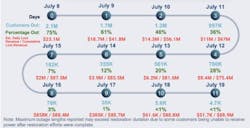
How much? Potentially millions per day. In a recently released whitepaper, our team at Noteworthy AI conducted an extensive analysis of the financials of large investor-owned utilities in hurricane-prone regions. Through this exercise, they estimated a daily lost revenue of $800,000 to $1.5 million for every 100,000 customers without power for 24 hours. The model drew on publicly available data from Southeastern and Gulf utilities, incorporating residential, commercial, and industrial usage patterns, demand charges, and weighted customer mixes.
Using a midpoint estimate of $1.1 million per day, and applying it to a scenario matching CenterPoint’s outage totals following Hurricane Beryl, the indirect revenue losses totaled roughly $89 million in unrealized supply, delivery, and demand charges—separate from the direct restoration costs of labor, materials, and equipment. See the overlay of estimated daily and cumulative losses in the figure below.
Extended outages are not just inconvenient; they drain resources and revenue. Power restoration becomes a race against both time and complexity. The solution is not adding more personnel, but increasing productivity through better tools that provide faster data, clearer visibility, and smarter workflows to reduce downtime.
In this era of digitalization and AI-driven edge technologies, it’s time to rethink the storm response playbook.
The 360° Lifecycle Model for Storm Response
Storm response has long followed a reactive model: assess the damage, restore power, and move on. But in today’s environment of frequent and severe weather, that linear approach no longer holds. Utilities need a continuous, adaptive model that treats storm response as a lifecycle—before, during, and after the event—improving grid resilience with each pass.
Pre-Storm: Proactive Grid Hardening: The foundation of resilience is preparation. Utilities can shift from rigid maintenance schedules to condition-based monitoring using AI and vehicle-mounted sensors. This enables early detection of failing components and produces up-to-date vulnerability maps. Rather than spreading resources thin, utilities can target interventions where they are needed most, stage crews strategically, and enter each storm with a stronger grid.
Immediate Post-Storm: Fast, Scalable Inspections: Speed is critical after a storm, but traditional pole-by-pole patrols are slow and labor-intensive. AI-powered vehicles can collect damage data while driving at normal speeds, allowing generalist drivers to cover large areas safely. When paired with drones, satellite imagery, and even foot patrols where appropriate, utilities can gain access to hard-to-reach areas without delay. This accelerates situational awareness, enabling more precise and efficient crew deployment.
Post-Restoration: Validation and Continuous Improvement: Restoring service is only part of the job, and verifying the quality of repairs is what ensures long-term reliability. AI-powered reinspections confirm that fixes meet specifications and uncover any lingering issues. These findings feed directly into the next pre-storm phase, creating a closed loop of learning and improvement. Each event becomes a catalyst for a stronger, more responsive grid.
Tools That Enable a 360° Approach
Supporting a 360° storm response requires scalable tools that help utilities manage the increasing complexity of extreme weather. No single technology is a silver bullet, but a combination of emerging tools makes the storm lifecycle model more effective and accessible.
Advanced sensing platforms, such as vehicle-mounted cameras, drones, and satellite imaging, enable utilities to scale inspections across both accessible and remote infrastructure. AI-driven analysis accelerates and standardizes data processing, identifying issues like broken poles, damaged insulators, and vegetation encroachments. In many cases, these tools can be operated by generalist personnel, increasing coverage without waiting on mutual aid or specialty crews.
Mobile platforms and edge computing enable near real-time data capture and integration into outage management systems and repair workflows. Together, they support smarter prioritization, faster mobilization, and clearer reporting, reducing restoration time and improving operational clarity.
This technology ecosystem is not about replacing people; it’s about equipping them with better data, visibility, and decision-making tools when the pressure is highest.
This technology ecosystem is not about replacing people; it’s about equipping them with better data, visibility, and decision-making tools when the pressure is highest.
Rethinking Operational Metrics
Modern storm response demands a shift in how success is measured. Time is money for utilities during post-storm restoration, yet damage assessment remains a major bottleneck due to outdated processes. Conventional storm patrols focus on maximizing crew size and minimizing hourly rates, yet still achieve only 2–3 MPH of grid inspections per two-person crew. As an example, during Hurricane Helene, Georgia Power mobilized over 20,000 personnel, including internal teams and mutual aid from multiple states.
In contrast, technologies like autonomous, vehicle-mounted cameras allow a single, minimally trained driver to safely patrol long spans of feeder circuits and laterals at the posted speed limit. Assessment results are delivered to command centers in near real time, with a complete audit trail. Other tools, such as active grid asset sensors, drones, and satellites, are also accelerating and expanding post-storm intelligence.
To fully leverage these emerging technologies, utilities must revise their workflows. Instead of the traditional focus on cost per hour, utilities should focus on the following metrics:
● Cost per pole or mile of grid inspected
● Poles or miles inspected per hour
● Restoration time per outage event or impacted customer
As shown in the chart below, the AI-enabled model drastically reduces cost and time. Reducing crew size, operator expertise, and increasing speed lowers the cost per pole from $5.00 to $0.33, while collection time is reduced and fleet capacity doubles.
By redesigning workflows around these metrics, utilities can increase productivity, speed, and transparency. In some cases, combining feeder and lateral inspections into a single, optimized route can double efficiency without expanding crews.
Why Every Day of the Lifecycle Matters
While extreme weather remains unpredictable by nature, it’s a fact that storms aren’t slowing down. The restoration model that worked yesterday is not equipped for tomorrow’s events. By adopting a 360° lifecycle strategy, utilities can shift from reactive recovery to proactive resilience.
This approach doesn’t just help restore power faster; it strengthens the grid with every storm. The time to modernize is now, and the path forward begins with a smarter foundation for inspection, coordination, and continuous improvement.
Related
About the Author
Chris Ricciuti
Chris Ricciuti, Founder & CEO, Noteworthy AI