From Pit Stops to Power Grids: The Impact of NASCAR's EV Prototype Collaboration with ABB
Key Highlights
- ABB and NASCAR showcased three EV prototypes at the Daytona 500, engaging fans with pit stop challenges and live demonstrations.
- The collaboration aims to promote conversations about electrification, grid modernization, and energy efficiency across industries.
- The project emphasizes the importance of infrastructure, including charging stations and grid capacity, for widespread EV adoption in sports and industry.
- ABB's initiatives support NASCAR's sustainability goals and highlight the business ROI of energy-efficient infrastructure at major venues.
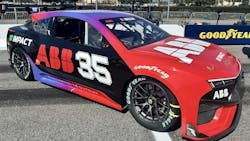
The feel of the roar of the engines is one thing that brings NASCAR fans to attend a live race, so it may come as a surprise that ABB and NASCAR have partnered on an EV prototype that they display and demonstrate at those very same live races. But that’s exactly what they have done, and it is truly helping to advance conversations around electrification and electricity reliability.
ABB and NASCAR brought out not one, but three EV prototypes for this past weekend’s Daytona 500, where they were featured in the ABB-Goodyear Pit Shop Challenge located at the ABB “Garage” right in the NASCAR Fan Experience section. Two developmental pit crews forming Team ABB and Team Goodyear raced in a simulated pit stop with NASCAR driver David Ragan operating the car (and adding some burnt rubber at the end of each “stop.”) Fans lined up against the fence to cheer on the crews and see the EVs perform.
Ragan wore a mic during some of the demos, talking through the feel and performance of the EV. “I was expecting to really be able to feel that weight difference, but it surprised me,” Ragan told us in a sideline interview. “I could feel the car a little heavier mid-corner, but with the increase of horsepower, all-wheel drive, and traction, you don’t notice any difference from an acceleration or deceleration standpoint. It actually handled very similar to what I’m accustomed to.”
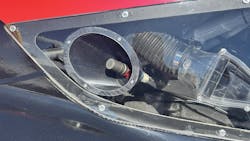
Conversation Piece
ABB is using the custom-built NASCAR EV prototype to spark broader discussions about the energy transition. The car was developed at NASCAR’s R&D Center in collaboration with Ford, Chevrolet, and Toyota and symbolizes cross-industry innovation.
“It's one of the only cars you'll ever see with all three automakers logos on it,” said Chris Shigas, ABB Vice President. He said that ABB’s partnership with NASCAR serves as both a technology demonstration and a national platform to advance conversations about electrification, grid modernization, and energy efficiency.
“NASCAR helps ABB reach the heart of America,” he said. “We take this EV prototype across the country to have better conversations about energy.”
Shigas said that while fans initially ask performance questions (speed, 0–60, regenerative braking), those conversations naturally evolve into deeper discussions about electrification, charging infrastructure, and grid capacity.
Over the past year, the EV prototype toured 20 states—from Manhattan to the Golden Gate Bridge—serving as a “vehicle” for fostering more balanced, informed dialogue about the country’s energy future.
Sustainability and ROI at Scale
ABB is also helping NASCAR evaluate and improve the energy efficiency of its infrastructure, including 15 major speedways. Energy efficiency, Shigas noted, is not just about sustainability—it’s about business ROI.
“When you start talking to customers about the business ROI of being energy efficient — how we can cut down massive electricity bills for these giant industrial systems — then you really have an agent of change,” Shigas said.
ABB is a founding member of NASCAR Impact, focused on improving infrastructure efficiency across venues like Daytona. The key themes for the Impact program include:
- Lowering massive electricity bills at large industrial facilities
- Aligning sustainability goals with financial performance
- Supporting NASCAR’s 2035 sustainability goals (reflected in the electric car’s No. 35)
EV charging is also part of the conversation around electrification. ABB provides high-powered DC fast chargers—but Shigas stressed that chargers are only part of the equation. Behind every charger is critical infrastructure, including switchgear, power protection systems and substation equipment. Utilities must ensure sufficient grid capacity before installing multiple DC fast chargers. ABB’s portfolio spans “source to socket,” from substations to charging systems, so the awareness can be a benefit to the company.
ABB’s recent projects for NASCAR include:
- Installing ABB EV chargers at NASCAR headquarters in Daytona
- Deploying an energy management system at the NASCAR R&D Center in Concord
- Using data to identify where energy is consumed and improve efficiency
Shigas emphasized that “use case” matters: Level 2 chargers are often appropriate for employees parked all day, rather than always defaulting to fast chargers.
Utilities, Grid Stability & the Future
Looking ahead, Shigas sees a more dynamic relationship between consumers and utilities. He described a future where:
- EVs and homes act as energy assets
- Consumers sell stored power back to the grid during peak demand
- Vehicles provide backup power during storms
- Energy becomes more of a tradable commodity
Ultimately, utilities want grid stability. Technology, he believes, will help enable more flexible, distributed energy systems.
Fast Facts about the NASCAR EV Prototype
- Weight: ~4,000 lbs
- Body: Generic CUV body styline made of flax fiber composite
- Chassis: Steel tubing with bolt-on front clip and front/rear bumpers
- Powertrain: 3x STARD UHP 6-phase motors AWD: 1x front and 2x rear
- Voltage Level: 756 VDC max
- Energy Content: 78 kWh
- Cooling: Water glycol
Efficiency as a Core Lesson
CJ Tobin, NASCAR’s director of Vehicle Systems, discussed what the organization has learned from developing its ABB NASCAR EV prototype — from battery management and safety engineering to energy efficiency and infrastructure planning — and how those lessons are influencing broader operations.
“With electric vehicles, it’s 100% about efficiency,” he said. “The efficiency of the battery, power management, what that looks like. And that’s something we’ve carried into other parts of our business.”
He said that conversations with ABB about vehicle power distribution led to deeper discussions about power distribution across NASCAR’s energy-intensive facilities, including R&D buildings that run multiple dynamometers and high-load equipment.
The EV program has helped NASCAR better understand how electricity moves from the grid into large facilities — and how to manage it more strategically.
Collaboration Across the Industry
The prototype was developed collaboratively by NASCAR R&D and OEM partners Ford, Chevrolet, and Toyota. Tobin noted that the entire industry has embraced the electrification conversation, viewing it as an opportunity for innovation and leadership.
Rather than positioning EVs as a replacement for traditional racing, NASCAR is using the prototype as a platform for dialogue, particularly with fans who might not otherwise engage in conversations about electrification.
“We have a lot of fans that grew up, like I did, with internal combustion engines,” Tobin said. “In a different setting, [they] would not want to talk about electric vehicles.”
Technical Performance & Testing
The EV prototype exceeded expectations during its first on-track test at Martinsville, completing three flawless test days, something Tobin described as rare for a brand-new vehicle platform.
On short tracks, where regenerative braking is most effective, the car achieved 67 laps on a single charge. Regeneration makes the platform particularly well-suited for short tracks and road courses.
While NASCAR is not currently racing the vehicle competitively, Tobin said the long-term vision is to create a race product that allows OEM partners to showcase electric performance.
For Tobin personally, and for NASCAR more broadly, working on the EV platform has reshaped perspectives. Developing the EV has provided firsthand insight into why electrification matters. The prototype serves as a bridge: It allows NASCAR to engage fans who might otherwise resist electrification and demonstrate key EV attributes like immediate torque and acceleration through showcases such as pit stop challenges.
The EV prototype is not replacing NASCAR’s core identity. It’s expanding it, while pushing efficiency, safety, and engineering excellence forward.
Read More
About the Author
 Nikki Chandler
Nikki Chandler
Group Editorial Director, Energy
Nikki is Market Content Director for the Endeavor Business Media Energy group, which includes T&D World, EnergyTech and Microgrid Knowledge media brands. She has 30 years of experience as an award-winning business-to-business editor, with 24 years of it covering the electric utility industry. She started out as an editorial intern with T&D World while finishing her degree, then joined Mobile Radio Technology and RF Design magazines. She returned to T&D World as an online editor in 2002, and took over as managing editor in 2017, then market content director in 2023. She has contributed to several publications over the past 30 years, including Waste Age, Wireless Review, Power Electronics Technology, and Arkansas Times. She graduated Phi Beta Kappa with a B.S. in journalism from the University of Kansas.