Grid Modernization: The Accelerator for the Future of Electric Transport
Key Highlights
- Electric buses significantly reduce emissions, noise pollution, and maintenance costs, making them vital for urban sustainability plans.
- Upgrading depots to centralized, high-capacity hubs reduces land use and improves operational efficiency, while supporting grid modernization efforts.
- Digital tools like charging management platforms and predictive analytics enable real-time monitoring, fault detection, and proactive maintenance, enhancing reliability.
- Funding programs such as Canada's ZETF and the U.S. IIJA are critical but have limited windows, requiring strategic planning and early collaboration.
- Workforce training and Generative AI tools are essential for managing organizational change and ensuring operational safety and efficiency.
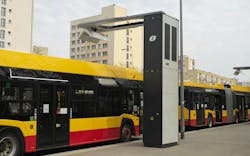
Across North America, major cities are starting to make the transition to electrify their bus fleets. Electric buses reduce emissions, cut noise pollution, and lower long-term maintenance costs compared to diesel, making them central to sustainability and urban livability plans. But as these ambitious initiatives start to roll out, one issue has become unavoidable for transit agencies: the infrastructure initially designed for diesel buses no longer fits the needs of high-power, space -efficient electric operations.
This shift concentrates large-scale electrical loads at depots and along high-frequency routes at particular times of day, reshaping demand and tightening reliability expectations for electric utilities. The question is no longer if fleets will electrify, but how utilities, agencies, and OEMs can work in tandem to modernize and digitize the grid to support large-scale, resilient operations without stranded assets or costly delays.
Funding and Mandates Are Condensing Timelines
In both the U.S. and Canada, multi‑year funding programs are driving adoption but come with limited windows. In Canada, the Zero Emission Transit Fund (ZETF) ($2.75B through 2026), Canada Infrastructure Bank’s ZEB Initiative ($1.5B+ loans), and iMHZEV incentives (up to $200K per vehicle) are major catalysts, alongside mandates like CleanBC and Quebec’s Plan 2030. In the U.S., the Infrastructure Investment and Jobs Act (IIJA) committed $108B to transit through FY2026, including $7.5B for charging and $2.5B for buses, complemented by FTA Bus Facility Grants ($1.5B in FY2025), not to mention, programs like EPA Clean Heavy-Duty Vehicles and RAISE. These programs continue for now, although it should be noted that uncertainty around U.S. budget priorities remains, and some funding streams have already closed. Agencies and utilities should plan with this in mind, as future availability may shift. According to recent industry surveys, more than half of transit agencies already operate low‑ or zero emission buses; roughly a third expect to complete transitions by 2035, and the majority anticipate‑ being fully electric by 2040. For utilities, that means compressed planning cycles and coordinated grid upgrades – not just for one depot, but often across multiple clustered sites.
From Pilots to Scale
Agencies are now moving beyond pilots, but the critical path to scale often runs through the utility. Substation upgrades, feeder capacity, transformer lead times, permitting, and utility crew availability frequently dictate project schedules. Real-estate constraints and the complexity of retrofitting older depots also add to the challenge. The risk is clear; if charging lags, buses sit idle. The remedy is early, joint planning, namely: feasibility and load flow studies, realistic interconnection timelines, and synchronized milestones for grid and depot buildouts.
Another critical path is at the agency level which must redesign or build new depots to accommodate large electrical infrastructure upgrades to allow the recharge of their new electrical buses. Traditional depots consume large amounts of real estate for fueling lanes, circulation, and idling patterns. This worked in the diesel era but is poorly suited to the electrical and spatial demands of modern fleets. This mismatch is driving a shift toward centralized bus charging depots – compact, high-capacity hubs that consolidate charging, optimize power delivery, and reduce costly land requirements. These facilities are emerging not only as the operational backbone of electric fleets but also as catalysts for broader grid modernization.
One such example is the centralized depot pilot approach adopted by Réseau de transport de la Capitale (RTC) in Quebec City, which illustrates how reorganizing charging equipment into structured, high-density‑ layouts dramatically reduces the physical footprint of overnight charging. Instead of distributing low voltage chargers across a site, centralized models‑ group switchgear, AC/DC rectifier and DC/DC chargers connected directly to the grid at the distribution medium voltage reduces lead time, risks and the ground space required for the electrical infrastructure upgrade. This approach allows a better distribution and control of the chargers while ensuring power quality and integrating digital charging management for smart charging & energy management in future expansion. This type of reconfiguration allows agencies to electrify within their pre-existing yards – an increasingly critical advantage as urban property values rise.Route planning is another factor to consider, and equally critical. For short, predictable routes, battery size and range are less of a concern, as charging can be integrated into the site’s broader energy strategy from day one. Longer duration routes, however, have minimal downtime, and present significant hurdles. With limited charging windows, additional vehicles or smaller buses with extended-range batteries may be required – in turn reducing service frequency and capacity, a downside for regular commuters. Flash charging at passenger stops, however, presents a promising solution for these high frequency routes, reducing reliance on depot-only charging.
What Centralization Means for Utilities
Beyond individual depots, centralized charging aligns closely with utility needs in the face of rising transportation loads, evolving grid constraints, and unyielding public expectations for reliable service. Instead of serving dozens of scattered chargers with inconsistent usage patterns, utilities can design single interconnections that support predictable overnight charging windows and clearly defined demand profiles. Concentrated load centers simplify capacity planning and improve the accuracy of load forecasts compared with fragmented pilot era deployments.
This is where grid modernization becomes essential. As electric fleets expand, utilities need to upgrade distribution systems to handle higher power demands, strengthen reliability, and gain better insight into how fleet operators use electricity – such as when and how much they charge. Centralized depots make this modernization more achievable: they are easier to meter, monitor, and manage as dispatchable load blocks. Digital charging systems can sequence and prioritize vehicles; shift charging into off-peak hours; maintain site load within contracted limits; and respond to local grid conditions – transforming depots from passive loads into flexible, grid-supportive resources. These same depots are ideal testbeds for integrating onsite renewables, hybrid storage, and demand response – further derisking peak impacts and enhancing resilience.
As electrification expands beyond transit – to commercial fleets, municipal services, and even school buses – utilities will experience unprecedented clustering of high-power demand around depots. Having a centralized model offers a practical framework to manage that shift, allowing feeders, substations, and distribution assets to be upgraded in phased, predictable increments.
Digitalization Is the Backbone of Scalable, Reliable Operations
As fleets grow, having the right software becomes just as critical as physical infrastructure. Digital tools – such as charging and energy management platforms, asset performance management (APM), predictive analytics, and digital twins – give operators and utilities real-time visibility into how buses charge, how equipment performs, and how much power depots draw. These insights allow agencies to schedule charging efficiently, detect faults before they happen, and plan maintenance proactively – boosting uptime and reducing total cost of ownership. For utilities, digitalized depots are a plus, providing accurate load forecasts, enabling managed charging during off-peak hours, and delivering reliable data for distribution planning. In short, digitalization turns charging sites into predictable, controllable assets rather than unpredictable stress points on the grid.
But digitalization alone isn’t enough if systems can’t talk to each other. As electrification scales, systems must work together seamlessly. Open standards and interoperable platforms prevent vendor lock-in, simplify integration of new chargers and vehicles, and keep operations flexible as technology evolves. This approach shortens the transition from pilot projects to full-scale deployments and reduces downtime caused by incompatible systems.
Workforce Readiness and Gen AI
Electrification isn’t just a technology shift – it’s an organizational one. Operators, mechanics, and dispatchers need new skills to manage electric fleets safely and efficiently. Structured training programs and early union engagement help smooth this transition. A promising accelerator is Generative AI: chatbot-style tools can provide real-time troubleshooting, consolidate institutional knowledge, and support onboarding as experienced staff retire. Utilities face similar challenges and would benefit from training for field crews and control-room teams to ensure grid reliability keeps pace with fleet growth.
Spreading the Cost and Reducing Risk
Yet, even with skilled teams and advanced technology, cost remains a major hurdle – making financing innovation essential. Upfront expenses for buses and charging infrastructure continue to be costly, and public funding cycles don’t always align with project timelines. Agencies are increasingly adopting innovative models – such as public-private partnerships, energy-as-a-service, and developer-led approaches – that spread costs over time and link repayments to operational savings. One such example is Hitachi ZeroCarbon’s joint venture with FirstGroup in the UK, which illustrates an innovative financing model in practice. The program enabled the acquisition of 1,000 bus batteries through a shared-investment approach, alongside charging and management services for 1,500 buses. The structure lowered capital requirements, deferred significant CapEx, and improved long-term battery utilization. In turn, utilities can play a key role by aligning grid investments with these financing strategies and designing pricing/rate schemes that reward predictable load behavior.
The Road Ahead for Scalable Electrification
The future of electric fleets depends on more than buses and chargers, it requires proactive utility engagement, digital integration, interoperable systems, and modern financing. Agencies that plan for scale from day one avoid delays and stranded assets, while utilities that provide early indications of electrical capacity and collaborate on standards and charging strategies accelerate timelines and strengthen reliability. Together, these steps create a more resilient grid, cleaner air, and a repeatable model for future electrification efforts.
About the Author
Daniel Simounet
Daniel Simounet is Vice President of Transportation Industry, North America.