Storm Response Strategies: Insights from Utility Industry Leaders
Key Highlights
- Utility companies prioritize safety through extensive training, storm drills, and sharing best practices to prepare crews for severe weather conditions.
- Technological innovations such as drones, smart grid devices, and mobile command vehicles significantly improve damage assessment and response efficiency.
- Pre-storm planning includes staging resources, establishing communication protocols, and setting up base camps to ensure rapid deployment and coordination.
- Emphasizing quality of work alongside speed helps prevent rework, reduces costs, and enhances long-term resilience against future storms.
- Collaboration across utilities and industry partners fosters a culture of continuous improvement and shared safety standards during storm recovery efforts.
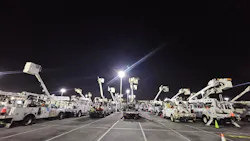
Michael Daddio, underground lead crew leader for ComEd, remembers the ice storm of 2016 like it was yesterday. Three inches of snow and ice covered the roads, and the wind was so strong, a parked car blew off the road and slid into a ditch. After 35 years at his industry, he has seen it all — from tornadoes to blizzards — which can inflict heavy damage in his service territory.
“High winds can knock poles and lines down, and winter storms can build up ice on lines and equipment, which can cause damage,” said Daddio, who started his career as a meter reader and worked his way up to mentoring foremen and leading teams of lineworkers. “Sometimes the ice buildup on lines causes outages without there being clear damage when viewed from a distance.”
He said he is proud to work for ComEd, which has the top reliability in the nation and is fully committed to upholding safety and doing thorough, efficient work. “Not every company is as safety-driven as we are. It’s a pretty awesome feeling to be a part of that.”
Coordinating Storm Response in Illinois
A nearby utility focused on safety and efficiency in storm response is Ameren Illinois. Kevin Place, director of electric operations, spent 26 years in the industry, with 15 of those years as a lineman.
While he was a lineworker in New York, he responded to Hurricane Sandy, and it was an experience he'll never forget. "This storm devastated entire communities and destroyed a significant amount of the infrastructure," Place said. "It was amazing to see the communities come together to support one another."
In his current role, he leads regional operations and oversees electric and engineering teams to ensure safe and reliable energy delivery. He also drives operational efficiency through process optimization, budget oversight, and labor relations management, along with fostering a culture of continuous improvement and community engagement aligned with Ameren's mission.
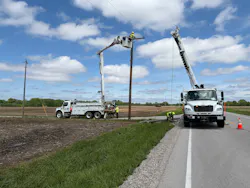
He also helps coordinate storm response following significant wind damage caused by storms throughout the year. Following the high winds in his service territory, line and tree crews clear the roads and lineworkers replace the broken poles.
To ensure that all the team members with storm roles are ready for whatever weather comes their way, Ameren Illinois organizes a robust annual training. "We also have multiple storm trailers stocked and ready to mobilize when needed," Place said.
Focusing on Storm Safety and Service Nationwide
TRC Companies, which supports dozens of utilities and co-ops across the country, makes safety a top priority when it comes to storm response, said Chris Duncan, director of distribution operations for TRC in Ohio, who has been in the utility industry for 18 years.
“Storm response is dangerous work, and we want everyone to get home to their families safely, so we put an enormous focus on that in our internal training and in the preparation we do with utilities and co-ops,” Duncan said. “We’re proud to have a record of zero safety incidents for our storm response teams across the dozens of deployments with thousands of team members.”
Throughout his career, storm response has been a major focus, Duncan said. He currently oversees a large storm response team that supports dozens of utilities and co-ops across the country. “We have hundreds of storm response professionals who act as an extension of utility crews to perform damage assessments, restore service and strengthen infrastructure,” Duncan said. “Our teams have been deployed to nearly every major storm over the past several years. We have also done long-term recovery work in locations hit particularly hard by hurricanes, including Puerto Rico, western North Carolina and the Gulf Coast of Florida."
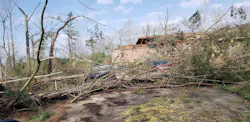
Because TRC works with so many utilities and co-ops across a large geographic area, its lineworkers have responded to every kind of severe weather event, including hurricanes, tornadoes, winter storms and other unnamed storms that are strong enough to disrupt service.
The damage depends on the severity of the storm, he said. In some cases, there may only be minor damage across a small area. Due to the impact of wind, debris and uprooted trees, it may only require a short deployment with a small number of teams. On the other hand, a severe event like Hurricanes Helene, Maria and Fiona may inflict much more damage across a larger area.
“In Puerto Rico, for example, many of our team members did months-long deployments helping residents regain service after those devastating hurricanes,” he said. “I’m incredibly proud of the work our teams do. In so many ways, they are on the front lines of helping communities recover from these disasters. And it is so rewarding to see the impact they have.”
One of the memorable recent storms, however, was Hurricane Milton in October 2024 for two reasons — it had a large deployment, and it came so soon after the large-scale Hurricane Helene response. “Hurricane Milton was an incredibly powerful storm that devastated the Gulf Coast with damage from the wind, storm surge and flooding,” he recalled. “The impact on the power grid was severe, and a large number of customers were without power for days.”
The Milton deployment came right after TRC had already deployed 132 storm responders for Helene recovery.
“Those teams had worked incredibly hard on a 16-day deployment there, and so many of them immediately volunteered to help with Milton,” he said. “It ended up being our largest deployment ever, with 152 storm responders supporting two utilities on the Gulf Coast. These deployments by our team are completely voluntary, and I am so proud of how many people stepped up, including those that had just done such tiring work for the Helene response.”
After responding to severe weather nationwide, both Daddio and Duncan offer their best practices and strategies for others so they can be prepared for anything that comes their way — even before a storm rolls into their service territory.
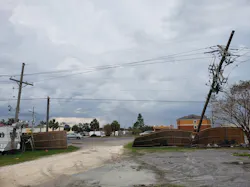
Sharing Best Practices for Storm Response
Be packed and ready to go. Daddio and the other lineworkers keep a three-day bag in their lockers. That way, if severe weather blows into their service territory, they can throw the bag in their bucket truck and be ready to hit the road for a long period of time. They also keep extra boots on their trucks just in case they get wet or snow-packed during storm restoration.
Practice performing storm repairs. The line crews at ComEd train for storms and emergencies, and they practice with a variety of simulated storm repairs on pieces of equipment commonly damaged from severe weather.
Conduct storm drills. At TRC, preparing for storm response is a year-round process. “The perception outside of the industry is that storm response is just for certain parts of the calendar, but we all know that it takes year-long planning and preparation,” Duncan said.
For example, TRC conducts extensive safety drills before teams are deployed, which allows them to react to real-world conditions for common and uncommon situations that exist in storm zones. In addition to internal training, TRC works closely with utilities to ensure there is alignment on safety processes.
Share safety best practices. In many cases, TRC’s best practices are more extensive because they respond to more storms than a smaller utility or co-op. In these situations, TRC takes on an advisory role to establish shared safety practices that can become organizational standard operating procedures.
“This kind of collaboration and sharing of best practices is one of the things I love about this industry,” Duncan said. “When storms happen, teams come together from across the country to help, and there is a true spirit of sharing and learning when it comes to safety.”
Partner with in-house storm response teams. TRC focuses on early planning with the utilities and co-ops that it supports by participating in planning and training with their in-house storm response teams. That way, they can ensure that they are aligned not only with deployment strategies, but also with technology.
“When teams come in from across the country to collaborate on a joint storm response effort, there can be coordination snafus and communication breakdowns that hinder the effort,” Duncan said. “That’s why we put a big focus not only on advanced planning, but also using the same processes, systems, technologies and applications as each of our clients. It allows us to operate within their workflows, using their preferred equipment and materials, following their best practices and working seamlessly as an extension of their team.”
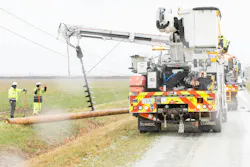
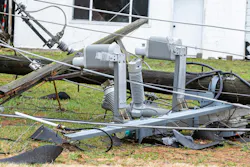
Set up pre-identified base camps. ComEd has base camps located all around its service territory with large parking areas set up as rally points. Crews can set up storm trailers, park trucks and have increased staff report to these pre-assigned staging areas.
Ameren Illinois also focuses on early communication and staging by discussing any additional resource requests ahead of any predicted major storms, Place said. "We have storm calls throughout the event to ensure we are moving resources where needed."
Keep everyone on the same page. When contractors come in to help, they must get onboarded to meet safety rules. In addition, they are required to learn the language used to talk to the dispatchers when they call into the operations control center.
“That’s what keeps us safe, and that’s our best practice because safety comes first,” Dadio said. “We want to turn everybody’s lights on as fast as possible, but if we don’t do it safely, then it’s for nothing.”
Invest in new tools and equipment. ComEd crews pilot different tools to see if they are the right fit for their processes. For example, the lineworkers rely on a ST800 service tester to expedite restoration. If they arrive at a house that’s missing one of three legs of power, they can clip on to it while it’s energized and then go to the source, whether it’s a transformer or pedestal. They can then find the exact cable they’re on so they’re not dropping another customer to fix the first one, which saves a lot of time, he said.
Leverage the power of drones. Daddio, a certified drone operator, said drones have become very helpful when it comes to storm inspection.
“I’m on the drone team, and on one of the storms this year, it was tough to find the damage causing an outage,” he said. “I flew the drone seven or eight miles down the line and found the issue after zooming in on the porcelains on certain poles. The cameras on our drones are incredible, and the zoom capability really helps to get a visual on equipment to see any abnormalities that would not otherwise be possible to see very easily.”
Place said Ameren Illinois also flies drones out following storms. The drone operators film footage of the impacted area to assess damage so the line crews can prioritize repairs and expedite restoration.
Assign a point of contact during storm response. At ComEd, a foreman or lead crew leader serves as a point of contact and knows where all the crews are situated during a storm response.
For TRC, one of their best practices is a safety-first model for team structure. For example, each crew has a highly experienced senior assessor who takes the lead on site assessment and remediation work. This person is paired with a driver who has significant safety responsibilities, not only while driving, but also when the assessor is out of the vehicle.
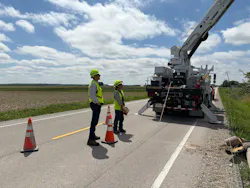
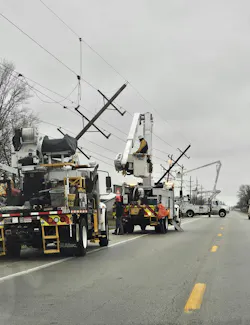
Infuse technology into the trucks. Most crews at ComEd have been upgraded to trucks with built-in computer systems so they can access maps and receive tickets and updates on the road. As a result, they can stay in constant contact and communicate more efficiently.
“That helps since the faster we can be in our communication processes and getting crews to the right places, the faster we can make repairs and restore power to customers,” Daddio said.
Layer clothing for better protection. Since he first started in the trade, Daddio said the clothes for lineworkers have gotten more advanced.
For example, they now have different options for hot and cold weather. During the summer, when they are restoring power following a storm, they can wear lighter clothing that is still more comfortable than heavier garments, and in the winter, they can layer clothing to stay safe in frigid conditions
Install smart devices in the field. Over the years, ComEd has invested in the grid by installing different pieces of equipment, like protective relay systems, which are all in communication to help to avoid, spot or restore outages.
“We have so much protective equipment on our overhead and underground systems,” he said. “Most of our system is in a loop and sends constant communication so we can pinpoint where outages and issues are at.”
In the future, he expects even more automation and protection technology to be added to the system. For example, he said he’s like to see a way for equipment and lines to automatically de-energize when damaged.
“When a line goes down, it would be de-energized before it hits the ground,” he said. “That would be the ultimate goal so it wouldn’t hurt anybody and would be huge for public safety.”
Establish a mobile command vehicle. For ComEd, the main innovations it has used for storm response technology come through accessibility.
“Our newest mobile command vehicle can essentially do everything that our main operations control center can do, but it can be brought out into the field and help crews directly in the hardest hit areas,” he said. “Having dispatchers on site during storm restoration helps greatly with efficiency and communication as crews can get printed maps, outage tickets, weather updates and work assignments from a localized point.”
Ameren Illinois also has a mobile command center. "We can use it for heavy hit areas, so we are close to the work and need," Place said.
Focus on quality of work, not just the speed of response. Duncan said one of the things he sees evolving in a positive way is the understanding that quality of work matters during storm response.
“The most urgent goal is to restore service, but if it’s not done right, this could become a large safety concern or a costly fix later,” he said. “Minimizing the need for rework after a storm response can save a significant amount of money for utilities and co-ops, and early planning and standards-setting is the way to achieve that.”
Because having the right incentives is important, utilities should consider building their contracts not just around speed, but also around quality, he advised.
“When you combine that with early planning and standards-setting, you can dramatically reduce the need for rework and can also drive practices that increase resiliency for the next storm,” Duncan said.
Rapidly Responding to Storms: ComEd’s New Mobile Command Vehicle
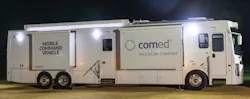
Over the years, ComEd has operated a fleet of storm response vehicles. The utility acquired its latest and most advanced vehicle — the Mobile Command Vehicle (MCV) — in December 2025 to replace a retired mobile command bus. This new vehicle cuts setup time from 90 minutes down to 10, saving valuable time in emergency response situations.
“It was designed to give restoration teams a modern, mobile operations center that can be deployed directly into storm-impacted areas,” said David Bunge, senior manager of emergency preparedness for ComEd. “By bringing communications, dispatching and restoration support closer to the work, the vehicle helps crews stay focused on restoring power safely and efficiently.”
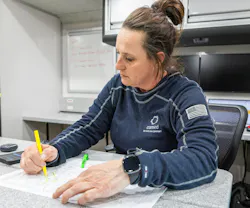
The MCV serves as a centralized operations hub in the field and provides crews localized access to maps, outage tickets and safety information. Restoration teams can receive work assignments, coordinate response efforts and communicate with crews from a single location. With built-in power generation and space for 14 workstations, the MCV can support restoration operations for up to three days without external power.
While the processes that the vehicle supports are standard, the major benefit is the efficiency and local crew oversight that it enables. Crews can receive work packages and job detail on site near the power outages instead of driving to the closest ComEd reporting center. This is beneficial to customers since it speeds restoration and increases work efficiency.
“Having storm response resources out in the field, closer to the damage helps streamline restoration operations and supports safe, efficient decision-making during major events,” Bunge said.
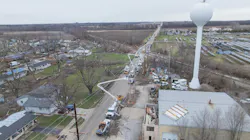
Following an EF3 tornado in Kankakee County on March 10, 2026, ComEd deployed the MCV during restoration efforts, and it provided a field-based command center. Restoration teams coordinated response activities, conducted damage assessment, accessed outage information and supported crews working in the affected area.
“The Mobile Command Vehicle helped bring critical resources and dispatchers closer to where the work was taking place, which makes communication processes even more efficient when every moment is critical,” Bunge said.
Reliable communications are essential during storm restoration, so we designed the MCV to have triple redundancy for cellular connectivity, with AT&T, Verizon and Starlink, so if any one of those systems goes down, another will pick up the connection. The vehicle also has built-in power generation, allowing crews to work in shifts uninterrupted for up to three days. That allows restoration teams to remain connected and continue coordinating response efforts even when local infrastructure is impacted.
“The MCV will continue supporting storm restoration efforts, emergency response activities, training exercises and special events,” Bunge said. “It is designed to provide flexible command-and-control capabilities wherever they are needed, helping ComEd coordinate response efforts and restore service safely and efficiently. It can also be taken on mutual assistance to support when ComEd crews are requested to help restore damage following storms in other states or regions of the country.”
Logistics and Supply Chain Management: Key to Efficient Power Restoration at Ameren Illinois
By Brian Bretsch , Ameren Illinois
In late July, a series of major storms swept through downstate Illinois over a two-week period, and Ameren Illinois crews restored power to homes and businesses that lost power. The weather events, including tornadoes, impacted multiple counties in the mid-section of the state, with several communities experiencing significant damage. In all, more than 300,000 outages were restored during the events.
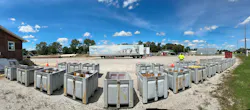
Restoring power in the wake of widespread weather events requires advanced preparation and a well-executed logistical response plan. Ahead of the forecasted storms, Ameren Illinois staged storm material trailers in the north and east regions of its service territory, ensuring crews had immediate access to essential equipment, tools and materials. Throughout restoration, the utility replenished the inventory continuously to keep pace with the scale of damage.
In total, crews replaced more than 850 utility poles and miles of downed power lines. In some harder hit areas, such as Charleston, lineworkers had to literally rebuild sections of the electric grid.
“Think of our storm trailers like a mobile warehouse," said Merit Vanpelt, senior manager of Supply Chain Operations for Ameren Illinois. "This mobile fleet contains essential materials our crews need to get a large number of poles, structures, wire and hardware in the air in a relatively short period of time."
Behind the scenes, the Ameren Illinois Material Distribution Facility crews support field-based teams by fulfilling material replenishment orders throughout the event. Strategic internal processes enable continuous material availability in abundance statewide.
Strong partnerships with suppliers ensure just-in-time availability of critical materials. Most of the company’s wooden poles are sourced from Bridgewell Resources Utility & Construction Group in Bluford, Illinois, which maintains a continuous inventory of power poles dedicated to Ameren Illinois. As storm response efforts ramped up, Bridgewell coordinated pole shipments to affected areas.
When severe weather is forecast, Ameren Illinois activates not only its crews, but also its supply chain partners.
“When the company places crews and field support personnel on alert for a pending storm, pole distributors are contacted at the same time to be ready to roll shipments to assist in restoration efforts,” Vanpelt said. “In the event of a storm, we work with engineers and distribution design to assess how many poles are broken or damaged to make appropriate orders with Bridgewell.”
This coordinated approach – combining the Ameren Material Distribution Facility, pre-staged resources, mobile infrastructure and responsive supplier support – enables Ameren Illinois to quickly mobilize materials and personnel anywhere in its service territory, helping accelerate restoration while maintaining a strong focus on safety.
Logistical considerations even extend beyond hard materials, noted Steve Wolters, senior manager of electric operations for Ameren Illinois.
"We really have all the capabilities to manage the movement of people and product for a large-scale event," he said.
About the Author
Amy Fischbach
Electric Utilities Operations
Amy Fischbach is the Head of Content for T&D World magazine and manages the Electric Utility Operations section. She is the host of the Line Life Podcast, which celebrates the grit, courage and inspirational teamwork of the line trade. She also works on the annual Lineworker Supplement and the Vegetation Management Supplement as well as the Lineman Life and Lineman's Rodeo News enewsletters. Amy also covers events such as the Trees & Utilities conference and the International Lineman's Rodeo. She is the past president of the ASBPE Educational Foundation and ASBPE and earned her bachelor's and master's degrees in journalism from Kansas State University. She can be reached at [email protected].