From Power Lines to Prairie Habitats: How a Naturalist Engineer Champions Sustainability
Key Highlights
- Joey Anthony balances his role as a managing engineer with his passion for ecology, demonstrating the importance of environmental awareness in utility work.
- He completed the University of Illinois Extension’s Master Naturalist program during the COVID-19 pandemic, gaining skills to support local conservation efforts.
- Anthony’s work includes relocating beehives, building habitats for declining species, and conducting freshwater mussel surveys to monitor ecosystem health.
- His innovative approach transforms old power poles into nesting boxes, exemplifying sustainable reuse and habitat creation.
- Anthony advocates for curiosity and small actions in environmental stewardship, emphasizing that everyone can make a positive impact.
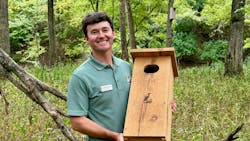
In the world of electric distribution, safety, precision and reliability are paramount. But for Joey Anthony, East Region managing engineer for Ameren Illinois, the job doesn’t end when the voltage stabilizes. Beyond the substations, power line extensions and smart grid technology, Anthony is also a certified master naturalist through the University of Illinois Extension — a role that brings ecological awareness into the heart of infrastructure planning.
Anthony’s journey began at the University of Illinois Urbana-Champaign, where he earned his electrical engineering degree in 2011. He joined Ameren Illinois the following year at its Paxton Operating Center, diving into the technical challenges of grid modernization and system reliability. But engineering wasn’t always smooth sailing.
“I wasn’t a straight-A student in college,” Anthony admits. “It was humbling. You go from being one of the smartest kids in high school to realizing you’re surrounded by brilliant minds.”
He credits perseverance, coffee and a late-blooming study group for helping him push through. His time as a saxophone section leader in the Marching Illini also gave him a creative outlet and a much-needed balance to the rigors of engineering.
A Natural Curiosity
Anthony’s love for nature wasn’t inherited — it was instinctive. Childhood days spent exploring creeks and catching frogs near the Kankakee River planted the seeds of curiosity. But it wasn’t until the COVID-19 pandemic that those instinctive roots truly took hold.
“Suddenly, everything was shut down,” he recalls. “So, we started hiking — more that year than I had in the previous decade.” That outdoor immersion led him to discover the University of Illinois Extension’s Master Naturalist program, inspired in part by a neighbor and master gardener named Carlo.
Despite working full-time at Ameren Illinois, Anthony completed the hybrid certification program in 2021, attending Zoom lectures and Saturday field days. He studied Illinois’ diverse bioregions — prairies, wetlands, forests — and completed 60 hours of volunteer work to earn his badge. He now maintains his certification with ongoing education and service.
Where Engineering Meets Ecology
Anthony’s world as an engineer and naturalist often intersect in unexpected ways. One standout example involved a line extension project in Urbana, Illinois, where a maple tree designated for trimming housed a thriving beehive.
“The easy answer was to remove the hive,” he says. “But I knew that wasn’t right.”
Drawing on his naturalist training, Anthony coordinated with the Champaign County Beekeeping Society to safely relocate the bees, preserving both the ecosystem and the project timeline.
“It’s about being aware of what’s around you,” he says. “Even in utility work, you can make choices that respect the environment.”
Joey’s Picks: Native Species That Inspire
Anthony’s garden is a living testament to biodiversity, designed not just for beauty but for ecological impact. Here are some of his favorite species.
Favorite Tree: White Oak. As Illinois’ state tree, the white oak holds a special place in Joey Anthony’s heart — and in the ecosystem.
“Oaks are keystone species. They support hundreds of caterpillars, moths and butterflies. They feed birds, turkeys and all kinds of ground critters. Everyone should want to plant oak trees.”
Favorite Prairie Plant: Pale Purple Coneflower. Among the rich tapestry of Illinois’ tallgrass prairie, Anthony finds himself drawn to the pale purple coneflower. “It’s a great nectar source from May through July, and it’s beautiful all season. I leave it standing through winter — It adds texture to the garden and feeds finches long after the blooms fade.”
Honorable Mentions:
Prairie Dock – admired for its towering presence and deep roots.
Common Milkweed – essential host plant for monarch caterpillars.
Nesting Boxes and Repurposed Poles
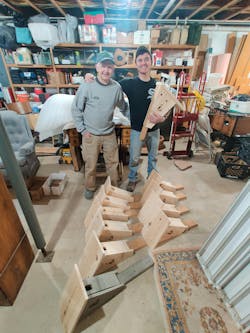
Anthony’s conservation efforts extend beyond his day job. As president of the Upper Sangamon River Conservancy, he leads the Nest Box Committee, building habitats for declining species like bluebirds and wood ducks. When a transmission upgrade replaced old cedar poles, Anthony saw an opportunity.
“I asked the foreman to leave me a few sections,” he explains.
With help from his father-in-law, a skilled woodworker, and a local mill, those poles were transformed into Peterson-style bluebird houses and wood duck boxes — crafted from the very power poles that once carried electricity.
Mussels, Macroinvertebrates and Monitoring
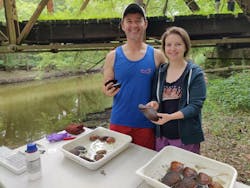
Among his favorite projects is the annual freshwater mussel survey in the Upper Sangamon River, where volunteers identify species that serve as indicators of water quality.
“We’ve found about 25 species,” Anthony says. “If they’re thriving, it means our ecosystem is healthy — for wildlife and for people.”
His favorite moment as a master naturalist occurred in 2023. He was with a group doing some citizen science work collecting mussels to measure and tag when he added one to his bag that he knew was special. However, the malacologist was a bit stunned by his discovery. Anthony found a slipper shell mussel — a species that hadn’t been recorded in the Sangamon River since 1991 and a state of Illinois Species in Greatest Conservation Need.
“That find was thrilling,” he says.
He also participates in macroinvertebrate surveys, studying aquatic insects that reveal the health of local streams. These efforts reflect a broader philosophy: that stewardship and science go hand in hand.
A Model for Integrated Thinking
Anthony’s story is a reminder that engineering and environmentalism aren’t opposing forces — they’re complementary disciplines. Whether he’s designing a line extension or surveying river mussels, Anthony brings a holistic mindset to every challenge.
“I’m always thinking about natural history,” he says. “It’s part of how I see the world now.”
He adds, “I would encourage all people to be curious and to try and learn the names of things in nature around us. It’s easier to love something when you know its name. Also, everyone can make an impact … just start small and dream big.”
In an era where sustainability is no longer optional, professionals like Anthony are leading the charge — proving that the grid can be green, and that even a transmission pole can find new life as a home for a bluebird.
Joey’s Picks: Native Species That Inspire
Anthony’s garden is a living testament to biodiversity, designed not just for beauty but for ecological impact. Here are some of his favorite species.
Favorite Tree: White Oak. As Illinois’ state tree, the white oak holds a special place in Joey Anthony’s heart — and in the ecosystem.
“Oaks are keystone species. They support hundreds of caterpillars, moths and butterflies. They feed birds, turkeys and all kinds of ground critters. Everyone should want to plant oak trees.”
Favorite Prairie Plant: Pale Purple Coneflower. Among the rich tapestry of Illinois’ tallgrass prairie, Anthony finds himself drawn to the pale purple coneflower. “It’s a great nectar source from May through July, and it’s beautiful all season. I leave it standing through winter — It adds texture to the garden and feeds finches long after the blooms fade.”
Honorable Mentions:
Prairie Dock – admired for its towering presence and deep roots.
Common Milkweed – essential host plant for monarch caterpillars.