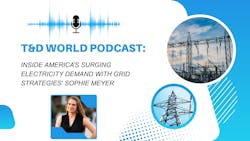
Inside America’s Surging Electricity Demand with Grid Strategies' Sophie Meyer

According to new analysis from Grid Strategies the grid is now facing its fastest demand growth since the mid-20th century. In this episode we speak with Sophie Meyer, Director of Power Systems at Grid Strategies, about what’s driving the sudden surge in demand, how utilities and grid operators are struggling to keep up, and what the implications are for reliability, affordability, and long-term planning.
Jan. 9, 2026
6 min read

Watch Now!

For nearly two decades, electricity demand in the United States barely moved. Annual growth stayed under 1%, driven down by efficiency improvements and the outsourcing of energy-intensive manufacturing. According to new analysis from Grid Strategies, that era is over — and the grid is now facing its fastest demand growth since the mid-20th century 

In this episode we speak with Sophie Meyer, Director of Power Systems at Grid Strategies, about what’s driving the sudden surge in demand, how utilities and grid operators are struggling to keep up, and what the implications are for reliability, affordability, and long-term planning.


A historic shift in electricity demand

Grid Strategies’ recent analysis of FERC Form 714 filings shows that utilities and planning authorities now forecast 166 gigawatts of new electricity demand by 2030 — more than six times higher than projections made just three years ago. Meyer compares the scale of this growth to adding roughly 15 New York Cities’ worth of peak demand to the U.S. grid within the next four to five years

The primary driver is data centers, which account for more than half of the projected growth. However, Meyer emphasizes that the story is much broader. A resurgence in U.S. manufacturing, electrification in the oil and gas sector, mining activity, and growing electrification of transportation and buildings are all contributing to rising demand. In regions like California, electrification alone accounts for roughly two-thirds of projected load growth over the next five years.

Why serving this load is so difficult

Meeting this level of growth presents an enormous challenge. Meyer explains that the grid is strained at every level — generation, transmission, interconnection, and equipment supply chains. Transmission development, in particular, has lagged for years. Even with increased investment in regions like Texas, SPP, and MISO, utilities would need to build generation and transmission roughly six times faster than recent historical rates to keep pace.

Interregional transmission emerges as a critical tool, especially during extreme weather events, by allowing regions to share resources and balance demand. But long permitting timelines make new lines slow to deliver. As a near-term solution, Meyer highlights grid-enhancing technologies and high-performance conductors, which can increase capacity on existing lines in months rather than years.

Interconnection is another major bottleneck. New generation simply isn’t coming online fast enough to serve new load. Grid Strategies advocates for tighter coordination between transmission planning and interconnection processes, better use of existing system headroom, and faster, more automated study processes to accelerate deployment.

Uncertainty — but not denial

Despite the eye-catching numbers, uncertainty is a major theme of the discussion. Utilities are still adapting their forecasting methods to account for very large, highly concentrated loads like data centers. Meyer notes that there is limited historical data to rely on, making precise projections difficult.

Grid Strategies attempted to quantify this uncertainty by comparing utility forecasts with data from financial analysts, chip shipment projections, and known data center developments. Their conclusion: nationwide data center load may be overstated by about 25 gigawatts. Even so, Meyer stresses that this does not change the overall conclusion. Even after adjusting for possible overestimation, the U.S. is still facing roughly 140 gigawatts of load growth by 2030 — far beyond recent norms 

The key takeaway, she argues, is that while the exact magnitude is uncertain, the surge itself is real. Waiting for perfect forecasts before investing risks reliability and economic growth.

Implications for generation planning

One of the more surprising findings discussed in the episode is the difference between projected growth in peak demand and total energy use. While peak demand is expected to grow at about 3.7% annually, energy consumption is forecast to rise at 5.7% per year. This suggests higher load factors and fewer low-demand hours.

Data centers play a role, given their high and relatively constant electricity usage, but they are not the only factor. Electrified winter heating, particularly in regions like New York, is also pushing up off-peak demand. This trend has major implications for resource mix decisions.

Meyer explains that peak capacity is often supplied by batteries or gas-fired peaking units, while energy needs are more efficiently met by solar, wind, and high-utilization gas generation. Gas is currently being deployed rapidly, but turbine supply constraints mean it cannot scale indefinitely. As a result, planners must carefully balance fast-deploying, lower-cost renewable resources with firm capacity to meet reliability needs.

Local impacts and who pays

While national forecasts provide a high-level view, the local impacts can be dramatic. In some small or rural utility territories, a single data center can exceed the electricity demand of the entire surrounding community. Although rural areas may find it easier to physically deliver power than congested urban centers, the scale of the impact forces utilities to rethink planning assumptions.

The conversation also addresses consumer concerns about rising electricity bills. Meyer outlines a growing set of regulatory tools designed to protect ratepayers, including minimum bill requirements, long-term contracts, and upfront cost contributions from large customers. These measures aim to prevent scenarios where infrastructure is built for speculative load that never materializes — a concern heightened by past experiences with crypto mining operations.

At the same time, Meyer notes that some grid investments, particularly transmission upgrades that reduce congestion, can benefit all customers. Grid Strategies estimates that U.S. consumers paid $12 billion in added costs due to transmission congestion in a single year, underscoring the value of well-targeted investment.

A grid-defining moment

The episode concludes with a recognition that the policy and regulatory framework for addressing this challenge is still evolving. Federal agencies, state legislatures, public utility commissions, and regional grid operators are all grappling with how best to respond — often on accelerated timelines.

For Meyer, the message is clear: the U.S. power system is entering a pivotal moment. Whether driven by AI, industrial growth, or electrification, electricity demand is rising faster than it has in generations. How quickly and thoughtfully the grid adapts will shape not only reliability and affordability, but the broader trajectory of economic growth in the years ahead

Contributors:

About the Author

Christina Marsh

Senior Editor

Christina Marsh is senior editor of T&D World at Endeavor Business Media (EBM), responsible for managing, editing, and contributing to the print issue production in addition to e-newsletters and digital content including podcasts. Previously, Christina was editor of Airport Business at EBM where she was responsible for contributing editorial support for the magazine, writing and compiling e-newsletters as well as contributing to digital content including producing video and podcasts. Before working with EBM, Christina was a multimedia journalist and podcast producer at The Experimental Aircraft Association (EAA). She graduated with a B.S. in journalism from the University of Wisconsin Oshkosh. 


Sign up for our eNewsletters
Get the latest news and updates

Voice Your Opinion!

To join the conversation, and become an exclusive member of TD World, create an account today!