Strengthening the Grid: Proven Solutions for Resilience and Coupling in Power Distribution
Key Highlights
- The energy transition is fundamentally reshaping the requirements for grid support infrastructure.
- Distribution- or industrial- network operators need technology partners who understand both the physics of power systems and the realities of field deployment.
- Effective solutions are not off-the-shelf – they result from thorough analysis of site-specific stability challenges and network requirements, translating into configurations tailored to each operator's needs.
The Resilience Problem
Modern grids are increasingly fragile. The retirement of conventional power plants removes rotational inertia – the physical momentum of spinning generators that naturally resists frequency changes. Simultaneously, distributed renewable sources introduce variability and reduce fault current levels. The result is a grid more susceptible to disturbances, with less natural damping to absorb them.
Voltage and frequency stability have become critical concerns as renewable penetration increases. Traditional synchronous generators inherently regulated voltage through their rotating magnetic fields and stabilized frequency through their physical inertia. Inverter-based resources lack these characteristics – and may reduce output or disconnect during disturbances precisely when the grid needs support most. The Iberian blackout of April 2025 demonstrated how quickly cascading voltage instability can propagate through networks with insufficient dynamic reactive power support. For utilities, often even on a distribution level, the message is clear: dynamic voltage and frequency control is no longer optional.
Comparing Grid Support Technologies
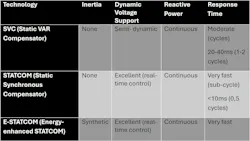
Several technologies address grid stability, each with distinct characteristics. Understanding their differences is essential for selecting the right solution.
SVCs (Static VAR Compensators) use thyristor-controlled reactors and capacitors to provide reactive power compensation. They respond within cycles but contribute no inertia and have limited overload capability. STATCOMs (Static Synchronous Compensators) employ voltage-source converters for faster, more precise reactive power control. Like SVCs, they lack inherent inertia, but offer superior dynamic performance, sub-cycle response times, and a significantly smaller footprint. E-STATCOMs add energy storage to the STATCOM platform, enabling synthetic inertia response and brief active power injection – bridging the gap between pure reactive compensation and true inertia support.
From Grid-Following to Grid-Forming
Inverter-based resources have traditionally operated in grid-following mode, synchronizing to the grid voltage and injecting current accordingly. This works well when synchronous machines establish the voltage reference – but becomes increasingly problematic as those machines retire.
The industry is moving through a clear progression. Grid-following inverters track grid voltage and frequency. Droop control allows inverters to adjust output based on frequency and voltage deviations, providing primary response. Grid-forming (GFM) inverters go further: they actively establish voltage and frequency, behaving like voltage sources rather than current sources. This capability is increasingly required for weak grid applications and high-renewable penetration scenarios, but demands robust hardware, sophisticated controls, and thorough testing.

Grid Coupling: Connecting Weak Grids and Microgrids
Beyond resilience, many distribution- or industrial network operators face the challenge of connecting weak grids or microgrids to the main network. These interconnections require careful management of power quality, fault current, and stability margins. Effective power-electronics based grid coupling solutions must handle bidirectional power flow, maintain synchronization across varying conditions, and provide sufficient fault current for protection coordination.
Whether connecting remote renewable installations or isolated communities, the coupling point becomes critical infrastructure that demands the highest level of reliability. Innomotics Grid Coupling solutions provide features here focusing on availability and fault tolerance.
From Portfolio to Partnership
The energy transition is fundamentally reshaping the requirements for grid support infrastructure. Distribution- or industrial- network operators need technology partners who understand both the physics of power systems and the realities of field deployment.
What distinguishes a reliable grid support solution goes beyond the technology itself. Critical infrastructure demands high availability through redundant architectures and fail-safe designs. It requires utility-grade quality – equipment built for decades of continuous operation under temperature extremes, contamination, and the rigorous duty cycles of grid support applications. And it depends on responsive service: with engineers and spare parts depots available globally, rapid response times and local expertise are essential to maintaining peak asset availability throughout a system's lifecycle.
Equally important is deep application expertise. Effective solutions are not off-the-shelf – they result from thorough analysis of site-specific stability challenges and network requirements, translating into configurations tailored to each operator's needs.
Innomotics brings together this full spectrum: a comprehensive portfolio spanning power electronics and large rotating machines, combined with the engineering depth and global reach to match the right solution to each specific challenge on a distribution level – such as coupling microgrids to the main network, or addressing power quality issues in industrial facilities.
Contact Innomotics today to discuss how our STATCOM, Grid Stability and Grid Coupling solutions can enhance the resilience and reliability of your electrical infrastructure.
Learn more at https://www.innomotics.com or contact [email protected]
This content is sponsored by: