Advancing Long-Term Forecasting for Tomorrow’s Grid
Key Highlights
-
Traditional long-term forecasting models are no longer sufficient as electrification, DER growth, EV adoption, extreme weather events and new large loads introduce unprecedented complexity.
-
The future of forecasting is granular, data-driven and bottom-up, with planners moving toward 8,760-hour modeling to capture the full range of load-shaping variables across every hour of the year.
-
Improving forecasting requires new processes, upgraded technology and stronger collaboration to enable planners at all levels to share data and better manage uncertainty across the grid.

Accurate long-term load forecasting and distributed energy resource (DER) forecasting are foundational to planning and operating reliable, resilient, affordable, lower-carbon electric grids.
However, massive change is arriving on the grid. The rise of extreme weather events, increasing levels of DER and electric vehicle (EV) adoption, continued building electrification, and a new generation of large loads led by data centers are driving the need for advances in the forecasting field.
A legacy forecasting approach disrupted by technology and behavior
In many instances, long-term forecasting still resembles the practice created for a centralized, single-direction electric grid using simple models that accounted for historical weather and high-level economic growth assumptions. The increasingly distributed, multidirectional nature of the grid, changing weather patterns, and customer electrification trends often aren’t reflected at the level of detail that planners require.
Making matters even more challenging, forecasting processes are often siloed. ISOs, RTOs, and utility transmission planners with a service-territory-wide view focus on system-level forecasts that predict annual total energy usage and peak demand over a period of 10-20 years. Distribution planners within utilities often use completely different data sets to forecast peak demand at the level of individual substations and feeders.
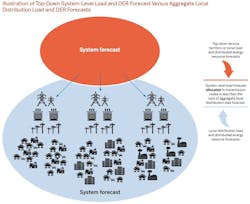
Moving forward, both system-level and distribution-level planners need to improve their forecasts by incorporating new methodologies that account for the disruptive changes to load. More variables mean forecasting is now more complicated, and the industry must respond to the complexity by understanding every hour of the year.
8,760 hours: The future of long-term modeling and forecasting
The vision for long-term load forecasting builds from the bottom up, using parcel-level load data that can be aggregated up to the feeder or substation level for distribution planners, all the way up to the system level for ISO/RTO forecasts. While the industry as a whole is not there yet, innovative planners and load forecasters across North America are building toward that future.
As forecasting evolves, “load-to-weather” modeling will remain relevant. These models depend on data to find the relationship between consumption behavior and temperature and humidity. However, there is relatively little data on these relationships during events like extreme heat and cold, and models often perform poorly in extreme scenarios. ISOs, RTOs, and research organizations are working to improve load-to-weather models with state-of-the-art climate modeling to account for the effect of increases in extreme weather.
Planners are also working to gain a better understanding of the emerging external load variables that are disturbing traditional models, such as DER and EV adoption and new large loads like data centers. In many instances, the scale of these changes is without historic precedent, and many planners lack the data to effectively model these new variables.
At the cutting edge — forecasts that account for climate changes and changing customer use patterns — planners are moving toward what is called 8,760 forecasting.
There are 8,760 hours in a year, and planners want to model the possibilities for every hour. This allows them to understand the impact of all the variables in the mix. For example, record heat on a mid-summer afternoon might not yield a demand peak on a system with high solar and battery storage adoption. But if demand response programs drain battery storage capacity by the time the sun goes down, when a large number of EV owners plug in to charge, that could be a recipe for a late demand peak. 8,760 forecasting solves those complex scenarios by modeling every variable over every hour of the year—both external variables like customer-owned DERs and EVs but also emerging utility-controlled ones like demand response and flexible load management resources.
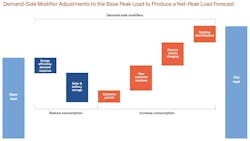
ISO and RTO planners are building toward that level of granularity. System-level planners will be the first to develop the 8,760-hour-based models that enable 8,760-model forecasts. Distribution-level planners need to understand and perform some 8,760 modeling, but likely won’t have the resources to achieve 8,760 forecasting in the near term. Eventually, however, everyone will have to get there to achieve the optimal bottom-up load forecasting vision.
Focus areas to prepare long-term forecasting for an era of complexity
Changing long-term load forecasting practices isn’t easy. However, it is possible to model emerging climate, consumer behavior, technology, and market changes. EPE Consulting has worked with planners at every level and recommends focusing on three areas to drive the necessary change:
1. Change processes
In the past, silos between system-level and distribution-level planners, which led to the use of different data and assumptions in separate models, didn’t harm planning outcomes. That’s not true anymore. In one instance, a utility performed a bottom-up study to forecast solar adoption in its territory. The ISO responsible for planning in the utility’s territory did the same without any of the same bottom-up data. The forecasts were hundreds of MW apart in their prediction for solar adoption, leading to a dispute that was settled by FERC in favor of the utility. The answer in these instances is to increase coordination, share data, and create a single common source of truth.
Another important process update is to incorporate the use of more scenarios in forecasting. More load-impacting variables means more complexity. Planners must evaluate more scenarios and improve their multi-scenario analysis to understand the range of risks of different outlooks that could develop. Relying on a single, deterministic future can create a false sense of certainty, obscure early warning signs of emerging rapid changes, and reduce decision-makers understanding of the tradeoffs and risks they are facing across the planning horizon.
2. Upgrade technology
The increased complexity of load forecasting has driven planners from simple spreadsheets to more complicated software tools. These tools provide access to common data sets for use by many and help planners run complex scenario analysis.
Planning organizations must leverage technology to improve their data collection and their use of that data to manage rising complexity.
3. Start collaborating
To fully break down silos and improve forecast quality, broad collaboration is a must.
When cross-departmental or cross-organizational groups are formed to discuss needs, individuals often discover their data requirements and modeling capability needs aren’t unique to their use case. What can be used to improve a distribution-level forecast can also be used to design better customer programs and rates, for instance. A single investment can serve many outcomes.
By developing strategies to evolve processes, technology, and collaboration, planners at every level can develop the modeling and forecasting capabilities required to better identify, understand, and manage the uncertainty associated with the complexities they face.
Sponsored By:

About the Author
 Julieta Giraldez, Ph.D.
Julieta Giraldez, Ph.D.
Director, Integrated Grid Planning, Electric Power Engineers
Julieta Giraldez is a nationally and internationally recognized subject matter expert in distributed energy resource (DER) grid integration with extensive expertise in grid modeling and planning processes. She currently works at Electric Power Engineers (EPE) as a Director of Integrated Grid Planning where she implements holistic approaches to meet customers’ needs through the optimized planning and operation of generation, transmission, distribution, and distributed resources. Prior to joining EPE, she served as a Director of Grid Planning at Kevala Inc., where she focused on implementing proactive capacity planning and electrification impact studies for utilities and regulators. Julieta also worked for a decade at the National Renewable Energy Laboratory (NREL) as a Senior Engineer where she led Smart Grid and Grid Integration related projects to manage emerging technologies such as PV, energy storage and microgrids in distribution systems. She holds a bachelor’s degree from the Polytechnic University of Madrid (Spain) in Technical Mining Engineering, a master’s in electrical engineering from Colorado School of Mines, and a Ph.D. program in systems engineering from Colorado State University.